
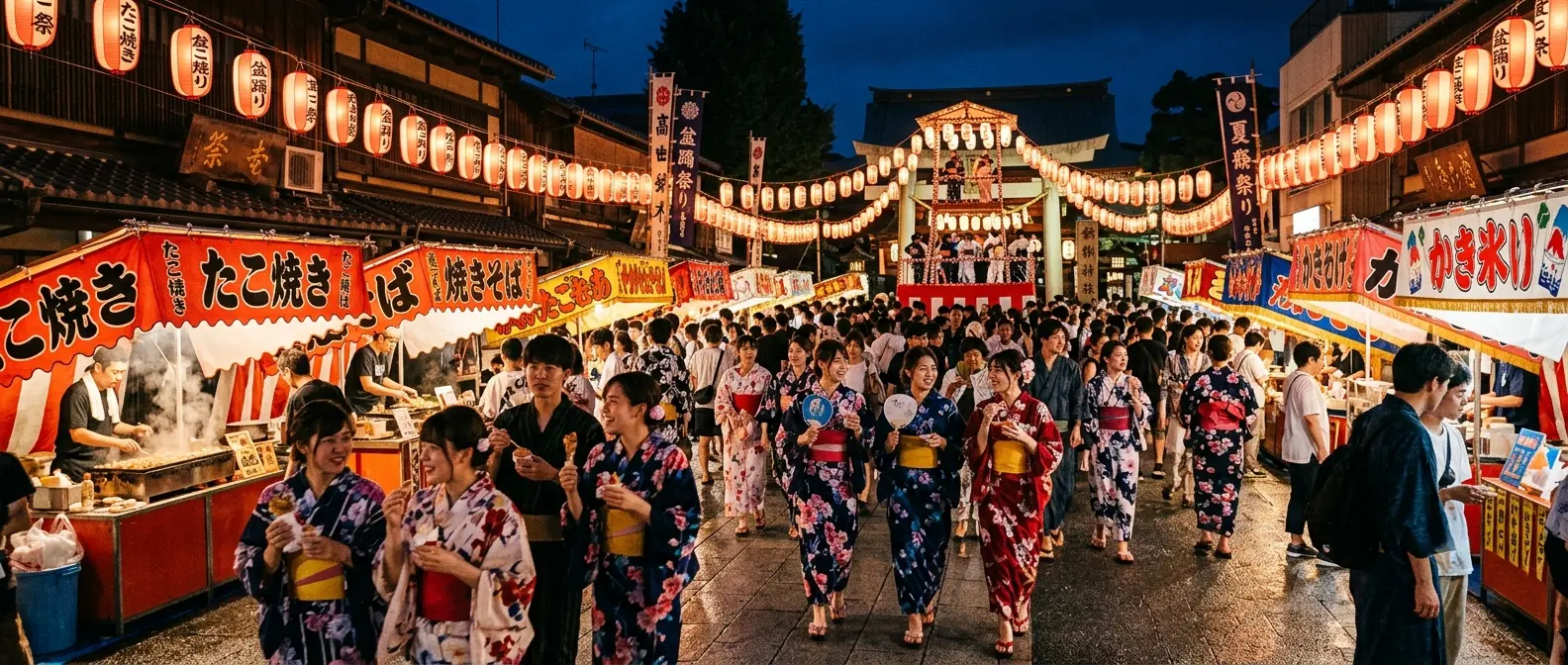
In Japan, a festival is rarely just a celebration. The word matsuri (祭り) is often translated as “festival”, but this translation does not fully express its original meaning. A matsuri is a moment of connection: between people and the sacred, between communities and their history, and between everyday life and the changing seasons.
Traditional Japanese festivals bring together rituals, processions, music, dance, food and collective participation. Some take place around local shrines, others commemorate historical events or regional traditions, but all share a common element: they create a temporary space where a community gathers and renews its bonds.
A matsuri is not simply something to observe. It is something to experience and participate in.
Demo Content Notice
Every article on this website is created to showcase the design features and content possibilities of this WordPress theme. The content about Japan is provided for illustrative purposes, may include simplified descriptions or minor inaccuracies, and should not be considered a substitute for official or authoritative sources.
From Sacred Rituals to Community Celebrations
Many Japanese festivals have their origins in ancient rituals connected with Shinto traditions and the relationship between humans and kami, the sacred presences associated with natural phenomena, places and ancestral forces.
In agricultural communities, festivals were closely linked to the cycles of nature. People gathered to pray for successful harvests, express gratitude for abundance, ask for protection from disasters or welcome the presence of a kami. Through offerings, ceremonies and processions, communities created a connection between the human world and the sacred realm.
Over centuries, these rituals evolved. While many matsuri continue to be associated with shrines and religious ceremonies, they also became important social occasions. They preserve local memories, strengthen relationships between residents and allow traditions to be passed from one generation to the next.
This combination of sacred meaning and communal celebration is one of the defining characteristics of Japanese festivals. A matsuri is not only a ritual belonging to the past, but a living tradition renewed every time people gather.
The Rhythm of the Seasons
The relationship between matsuri and the seasons reflects a broader characteristic of Japanese culture: an awareness of the changing natural world.
Traditional festivals often follow the rhythm of the year, marking important transitions in agriculture, climate and community life.
Spring festivals are frequently associated with renewal, growth and hopes for prosperity. As nature awakens after winter, communities celebrate new beginnings and the return of vitality.
Summer matsuri often have connections with purification and protection. Historically, many summer rituals were related to preventing illness and misfortune during a season when disease was a serious concern. Today, many summer festivals are also known for evening processions, fireworks and lively gatherings under lantern light.
Autumn festivals are commonly linked with gratitude for the harvest. They celebrate the results of agricultural work and express appreciation for the relationship between people and the land.
Winter traditions often focus on renewal and preparation for the new year. Many rituals during this period emphasise purification, continuity and the hope for good fortune in the months ahead.
Through these seasonal celebrations, matsuri express the idea that human life is not separate from nature, but part of a larger cycle.
The Elements of a Matsuri
Although every festival has its own unique identity, many matsuri share elements that have become recognisable symbols of Japanese celebrations.
One of the most important is the mikoshi (神輿), a portable shrine carried through the streets during a procession. The movement of the mikoshi symbolically allows a kami associated with a shrine to visit the surrounding community, bringing sacred presence into everyday spaces.
Another common feature is the presence of festival floats, known in different regions as dashi, yatai or by other local names. These elaborate structures are often decorated with historical figures, mythical creatures or traditional motifs, reflecting the artistic heritage of the communities that create them.
Music and performance also play an essential role. Drums, flutes, dances and theatrical performances transform the festival atmosphere, while clothing such as happi coats and yukata creates a visible connection with tradition.
Food stalls and local markets are also an important part of many modern matsuri. Although they may appear separate from the ritual aspects of the festival, they contribute to the social dimension of the celebration, creating spaces where people meet, share experiences and participate together.
Famous Festivals Across Japan
Japan’s most famous festivals demonstrate how local history and traditions shape each matsuri in a unique way.
The Gion Matsuri in Kyoto is one of the country’s oldest and most celebrated festivals. Its origins date back to the ninth century, when rituals were performed to seek protection from epidemics. Over time, it developed into a month-long celebration known for its magnificent floats, processions and the active participation of Kyoto’s neighbourhood communities.
The Tenjin Matsuri in Osaka is dedicated to the deity of Tenmangu Shrine and is particularly famous for its combination of land and river processions. Boats carrying participants and ceremonial objects travel along the waterways, creating one of Japan’s most distinctive festival scenes.
The Aomori Nebuta Festival is known for its enormous illuminated floats depicting warriors, mythical figures and historical characters. Their dramatic appearance reflects the creativity and craftsmanship of the region, while the accompanying music and dance create a powerful communal atmosphere.
Beyond these internationally recognised examples, thousands of smaller local matsuri continue throughout Japan. Many are deeply connected to individual towns, villages or neighbourhoods, preserving customs that might otherwise disappear.
The Community Behind the Celebration
The importance of a matsuri lies not only in its visible elements, but in the people who make it possible.
Preparing a festival often requires months of cooperation. Residents work together to build decorations, organise ceremonies, maintain traditional skills and teach younger generations how to participate.
This collective effort creates a sense of belonging. A festival allows people of different ages and backgrounds to contribute to something shared, reinforcing relationships within the community.
In modern Japan, some traditional festivals face challenges due to demographic changes and declining rural populations. However, many communities continue to adapt their celebrations while preserving their essential meaning.
A matsuri survives because it remains meaningful to the people who carry it forward.
More Than a Festival
Japanese festivals are not simply celebrations of the past. They are living expressions of cultural memory.
Through rituals, music, craftsmanship and collective participation, matsuri connect present generations with those who came before them. They preserve local identities while continuing to evolve with society.
A Japanese festival reminds us that traditions are not preserved only in museums or historical records. They remain alive when people gather, participate and create shared experiences.
In this sense, every matsuri is both a remembrance of what came before and a continuation of a tradition still being written.