
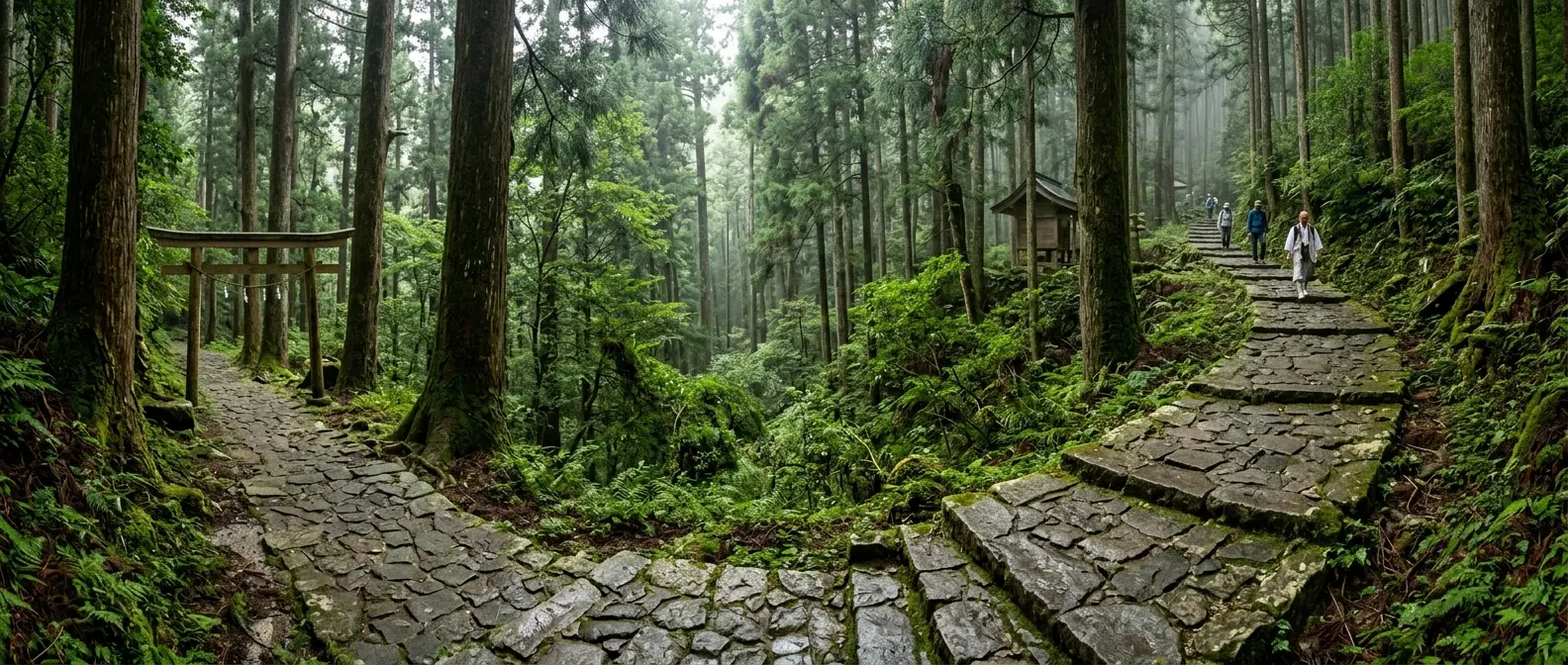
The Kumano Kodō is one of Japan’s most remarkable networks of ancient pilgrimage routes, crossing the forested mountains of the Kii Peninsula in Wakayama and surrounding regions. For more than a thousand years, these paths have connected sacred sites, natural landscapes and spiritual traditions, creating a journey in which the act of walking itself becomes part of the experience.
Unlike a pilgrimage focused only on reaching a final destination, the Kumano Kodō emphasises the relationship between movement, nature and reflection. The forests, rivers, mountains and small villages encountered along the way are not simply a backdrop, but essential parts of the spiritual landscape.
Today, the routes continue to attract pilgrims and travellers from around the world, offering an opportunity to experience a slower and more attentive way of moving through the environment.
Demo Content Notice
Every article on this website is created to showcase the design features and content possibilities of this WordPress theme. The content about Japan is provided for illustrative purposes, may include simplified descriptions or minor inaccuracies, and should not be considered a substitute for official or authoritative sources.
A Sacred Journey Through the Mountains
The Kumano region has been considered a sacred area for centuries, where mountains and forests were associated with spiritual forces and the presence of kami (神). The three major shrines of Kumano — Kumano Hongū Taisha, Kumano Nachi Taisha and Kumano Hayatama Taisha — form the spiritual centre of the pilgrimage tradition.
These shrines are collectively known as the Kumano Sanzan (熊野三山), and the routes connecting them allowed pilgrims to travel through a landscape believed to possess transformative power.
In 2004, the Kumano Kodō was inscribed as part of the UNESCO World Heritage Site “Sacred Sites and Pilgrimage Routes in the Kii Mountain Range”. This recognition highlights the exceptional cultural and spiritual importance of the ancient routes that connect the sacred sites of the Kii Peninsula.
Together with the Camino de Santiago in Europe, the Kumano Kodō is one of the world’s most significant historic pilgrimage networks recognised as a World Heritage site. Its value lies not only in the destinations it connects, but also in the relationship between the paths, the surrounding landscape and centuries of spiritual practice.
Historically, the pilgrimage was particularly associated with the imperial family and aristocracy during the Heian period (794–1185). Later, the practice became accessible to people from different social backgrounds, creating a tradition that combined religious devotion, physical endurance and personal reflection.
Walking as a Form of Transformation
The experience of the Kumano Kodō is inseparable from the landscape through which it passes. Unlike modern journeys designed primarily for speed and efficiency, pilgrimage routes encourage a slower rhythm in which the surrounding environment becomes part of the experience.
Walking through dense forests, climbing mountain paths and crossing ancient stone trails creates a connection between physical effort and inner reflection. The difficulties of the journey are not obstacles to overcome quickly, but elements that contribute to its meaning.
This relationship between movement and transformation reflects an important aspect of Japanese spiritual traditions: places are not only locations, but environments where experiences and memories accumulate over time.
Between Shinto and Buddhism
The spiritual character of the Kumano Kodō developed through the interaction of Shinto and Buddhism. For centuries, these traditions coexisted in the Kumano region, creating a unique form of religious practice known as shinbutsu shūgō (神仏習合), or the fusion of kami worship and Buddhist beliefs.
Sacred mountains could be understood simultaneously through different spiritual perspectives. Natural elements such as forests, waterfalls and peaks were not separate from religious practice, but active participants in the way people understood the sacred world.
This historical connection is one reason why the Kumano Kodō represents more than a route between shrines. It reflects a broader Japanese approach in which spirituality, nature and human experience are deeply interconnected.
Forests, Villages and Living Heritage
The Kumano Kodō is not only defined by its religious monuments. The paths pass through forests, rural communities and landscapes that have been shaped by centuries of interaction between people and nature.
Small settlements along the routes continue to preserve traditional ways of life, offering travellers a glimpse of a different relationship with time and place. The journey moves between sacred spaces and ordinary environments, showing how the two are not always clearly separated.
This continuity between human activity and the natural world is one of the defining qualities of the Kumano landscape. The pilgrimage survives not as a frozen historical monument, but as a living tradition that continues to evolve.
A Pilgrimage for the Modern World
In contemporary Japan, the Kumano Kodō has gained renewed attention as people search for experiences that contrast with the speed of modern life. The physical act of walking, the silence of the forests and the connection with ancient paths offer a different way of experiencing travel.
The pilgrimage does not require a single religious interpretation. For some visitors, it remains a spiritual journey; for others, it is an opportunity for reflection, cultural discovery and a deeper connection with nature.
What makes the Kumano Kodō remarkable is precisely this ability to connect past and present. Its paths preserve centuries of history while continuing to offer a meaningful experience for those who walk them today.