
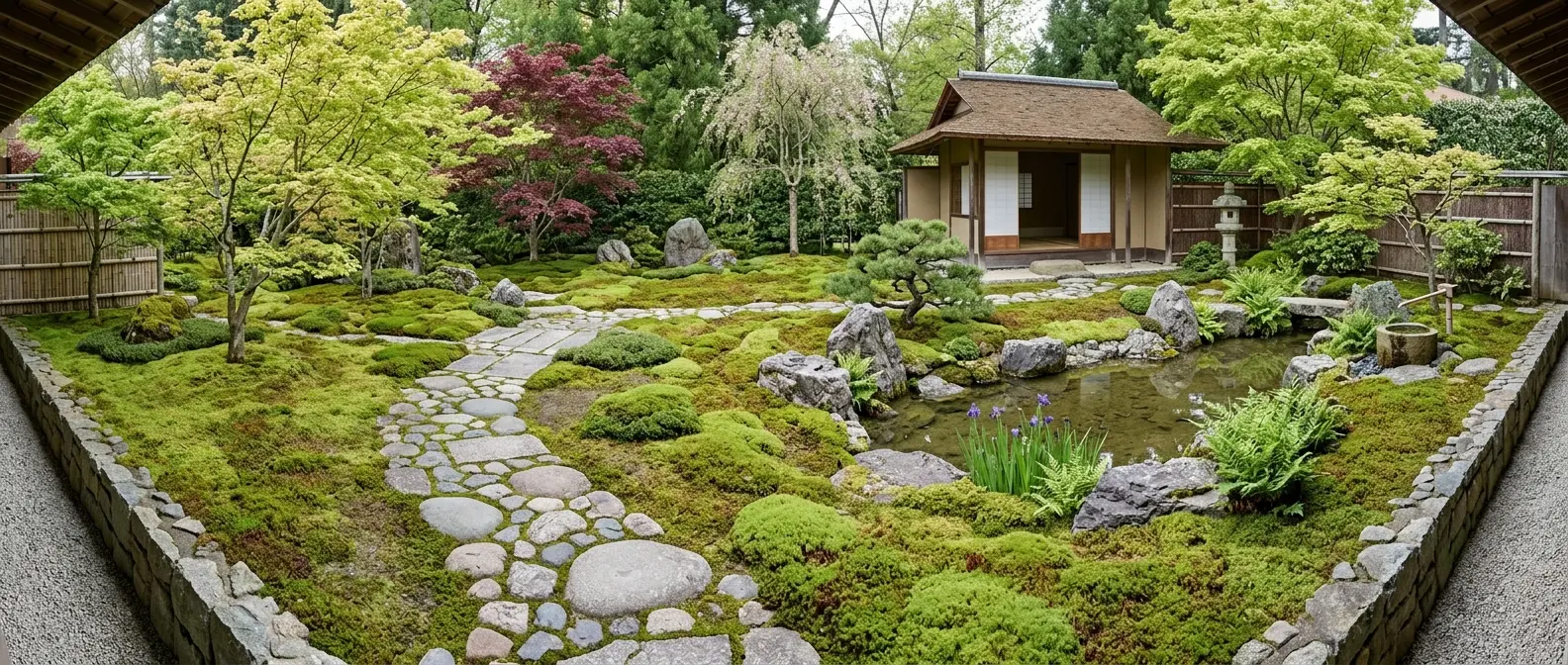
Among the many elements that define Japanese garden aesthetics, moss occupies a unique position. Unlike flowers that attract attention through colour and seasonal change, moss creates beauty through patience. It grows slowly, responds to its environment and transforms gradually over time, becoming a living expression of continuity and age.
In Japanese gardens, moss is not simply a decorative plant added to complete a landscape. It contributes to the atmosphere of a place, softening stones, covering surfaces and creating a sense of harmony between human design and natural processes.
A moss garden does not attempt to preserve nature in a fixed state. Instead, it celebrates gradual change. The passage of time becomes part of the composition itself.
Demo Content Notice
Every article on this website is created to showcase the design features and content possibilities of this WordPress theme. The content about Japan is provided for illustrative purposes, may include simplified descriptions or minor inaccuracies, and should not be considered a substitute for official or authoritative sources.
The Quiet Presence of Moss
Moss has long been appreciated in Japan for its subtle qualities. Its colours are often understated, ranging from deep green to softer shades that change with light, moisture and season. Rather than creating dramatic visual effects, moss contributes to a feeling of calm and permanence.
This quality makes it particularly suitable for gardens designed around contemplation. A stone covered slowly by moss, a pathway softened by vegetation or a wall marked by years of growth all become reminders that landscapes are not static objects but living environments.
Unlike ornamental plants chosen for immediate impact, moss reveals its character gradually. Its beauty depends on observation and attention to details that might otherwise be overlooked.
Saihō-ji and the Art of the Moss Garden
One of the most famous examples of moss garden design is Saihō-ji, also known as Kokedera or the Moss Temple.
Originally founded as a Buddhist temple and later transformed into a Zen temple during the medieval period, Saihō-ji became renowned for its extensive moss-covered landscape. More than a simple collection of plants, the garden creates an atmosphere where architecture, water, stones and vegetation exist together as a unified composition.
The garden contains many varieties of moss that developed over centuries in the temple’s shaded and humid environment. Rather than being artificially arranged into precise patterns, the moss creates a continuous surface that connects different elements of the landscape.
The result is a garden where time itself appears visible. The layers of growth and gradual transformation are not signs of ageing, but essential parts of its beauty.
Moss and the Japanese Appreciation of Time
The appeal of moss gardens is closely connected with broader Japanese ideas about impermanence and the acceptance of change.
In many Western traditions, gardens have often been designed around control, order and the preservation of a desired appearance. Japanese gardens frequently explore a different relationship with nature: one based on cooperation rather than complete domination.
Moss illustrates this approach particularly well. It cannot simply be placed and forgotten; it requires specific conditions and careful maintenance. Yet its growth is not entirely controlled. The gardener creates the environment, but nature continues the process.
This balance between intention and spontaneity reflects the aesthetic principle of wabi-sabi, where beauty can emerge from age, irregularity and the marks left by time.
A Landscape of Shade and Silence
Moss gardens often depend on conditions that encourage a slower, quieter experience. Shaded paths, moist stones and filtered light create environments that feel separated from the intensity of everyday life.
The absence of strong contrasts allows other elements to become more noticeable: the texture of bark, the sound of water, the shape of rocks or the changing atmosphere of the seasons.
In this sense, moss contributes not only to the visual appearance of a garden but also to its rhythm. It encourages visitors to move slowly and notice details that would disappear in a more dramatic landscape.
The garden becomes a place where attention shifts from individual objects to the relationship between all elements.
Beyond Decoration
The continued fascination with Japanese moss gardens comes from the way they challenge common ideas about beauty. They do not depend on perfection, speed or constant renewal. Their appeal grows from patience and gradual transformation.
A moss-covered stone carries evidence of time. A path softened by vegetation reveals the interaction between human presence and natural processes. A garden that changes slowly becomes a record of seasons, climate and care.
This perspective continues to influence contemporary landscape design, where natural materials, ecological approaches and appreciation for ageing processes have gained renewed importance.
Moss gardens remind us that beauty does not always require immediate impact. Sometimes it emerges quietly, through the accumulation of years and the careful relationship between humans and the natural world.