
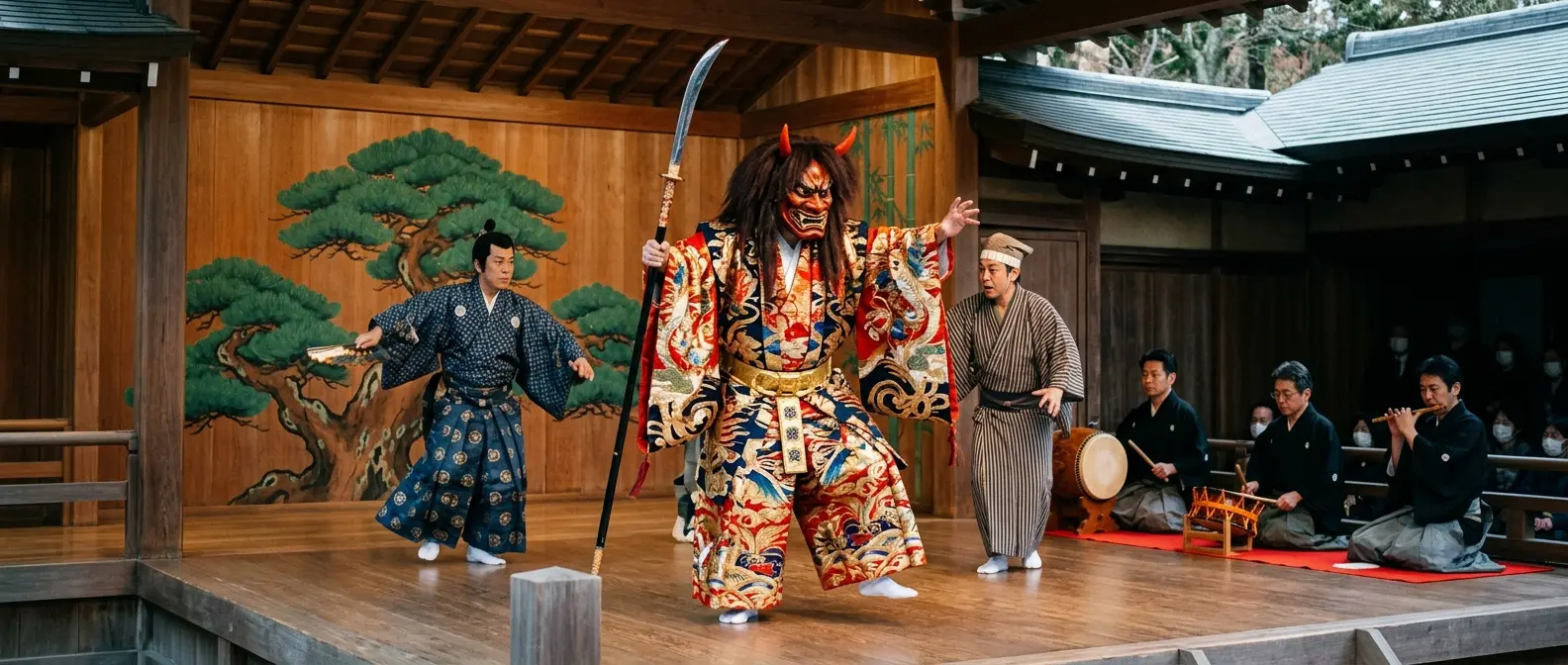
Among Japan’s traditional performing arts, Noh theatre stands out for its unique approach to storytelling. Rather than relying on realistic acting, elaborate scenery or fast-paced action, Noh creates meaning through subtle movement, symbolic gestures, music and silence.
Developed over centuries, Noh is one of the oldest forms of theatre still performed today. Its carefully preserved techniques, masks and musical structures continue to express a distinctive vision of beauty: one where emotions are suggested rather than openly displayed, and where what remains unseen can be as important as what appears on stage.
Noh is not simply a performance to watch. It is an experience built around atmosphere, suggestion and the relationship between movement and stillness.
Demo Content Notice
Every article on this website is created to showcase the design features and content possibilities of this WordPress theme. The content about Japan is provided for illustrative purposes, may include simplified descriptions or minor inaccuracies, and should not be considered a substitute for official or authoritative sources.
Origins of a Classical Art Form
The origins of Noh can be traced to medieval Japan, particularly to earlier forms of performance such as sarugaku, which combined elements of dance, music, acrobatics and storytelling.
During the Muromachi period (1336–1573), Noh developed into the highly refined theatrical form recognised today. Its transformation was closely connected with the work of Zeami Motokiyo, a performer, playwright and theorist who helped establish many of the artistic principles that define Noh.
Zeami’s writings explored ideas such as yūgen, a concept often associated with subtle beauty, mystery and depth beyond what can be immediately perceived. For Zeami, the power of performance did not come from displaying emotions directly, but from creating an atmosphere in which the audience could sense what lies beneath the surface.
Through this approach, Noh became a theatre of suggestion rather than explanation.
A Theatre of Masks and Movement
One of the most recognisable features of Noh is the use of masks known as omote. These masks represent specific characters, particularly spirits, supernatural beings, women or elderly figures.
Unlike a modern theatrical mask designed to exaggerate expressions, a Noh mask is deliberately restrained. A slight change in the angle of the performer’s head can make the same mask appear to express different emotions. A downward movement may suggest sadness, while a change in position can create the impression of a different expression.
Movement in Noh follows similarly precise principles. Performers do not imitate ordinary gestures or natural behaviour. Instead, they use a highly codified language of steps, poses and controlled movements developed through generations of training.
A simple action can carry symbolic meaning. Walking across the stage, turning the body or raising a hand may communicate emotions, memories or changes in the character’s state of being.
The Power of Silence and Space
Noh theatre demonstrates that absence can be as meaningful as presence.
The stage itself is intentionally simple, traditionally consisting of a wooden platform with minimal decoration. There are no elaborate sets designed to recreate realistic environments. Instead, the audience’s imagination completes the scene.
Music and silence play an equally important role. The performers are accompanied by a small ensemble called hayashi, which includes drums and a flute, as well as by the chanting of the actors known as utai.
The rhythm of Noh is slow and deliberate. Moments of stillness are not empty pauses, but carefully created spaces where tension and emotion can emerge.
This attention to what is left unsaid reflects a broader characteristic of Japanese aesthetics: meaning often appears through suggestion, restraint and the relationship between elements.
Stories Between the Human and Spiritual Worlds
Many Noh plays explore themes of memory, loss, transformation and the relationship between the human world and the supernatural.
A common structure involves a traveller or monk encountering a mysterious figure who later reveals a hidden identity, often as a spirit connected with a place, a past event or an unresolved emotion.
Rather than focusing on dramatic conflict, Noh often explores inner states: longing, regret, attachment and the search for peace.
The appearance of ghosts and spirits is not presented as something frightening or extraordinary. Instead, the supernatural world becomes a way to explore human emotions that continue beyond ordinary boundaries.
In this sense, Noh is not only a theatre of characters and stories, but also a theatre of memory.
Preserving a Living Tradition
Although Noh originated centuries ago, it remains an active performing art in contemporary Japan. Several traditional schools continue to train performers, preserving techniques that are transmitted directly from teacher to student.
Becoming a Noh performer requires many years of disciplined practice. Training includes learning movement, vocal techniques, musical structures and the specific conventions of each role.
At the same time, Noh has continued to find new audiences through performances, educational programmes and collaborations with contemporary artists. While its traditional foundations remain essential, its themes of emotion, memory and human experience continue to resonate beyond historical boundaries.
An Art of What Cannot Be Seen
The enduring fascination of Noh theatre comes from its ability to express what cannot easily be explained.
A gesture, a pause or the expression of a mask can suggest emotions deeper than words alone. Through simplicity and restraint, Noh invites the audience to participate through imagination and interpretation.
Like many traditional Japanese arts, Noh does not seek to overwhelm the senses. Instead, it creates a space where small details become meaningful and where silence can communicate as powerfully as sound.
After centuries of performance, Noh remains a reminder that art does not always need to show everything. Sometimes its greatest strength lies in what it allows us to discover.