
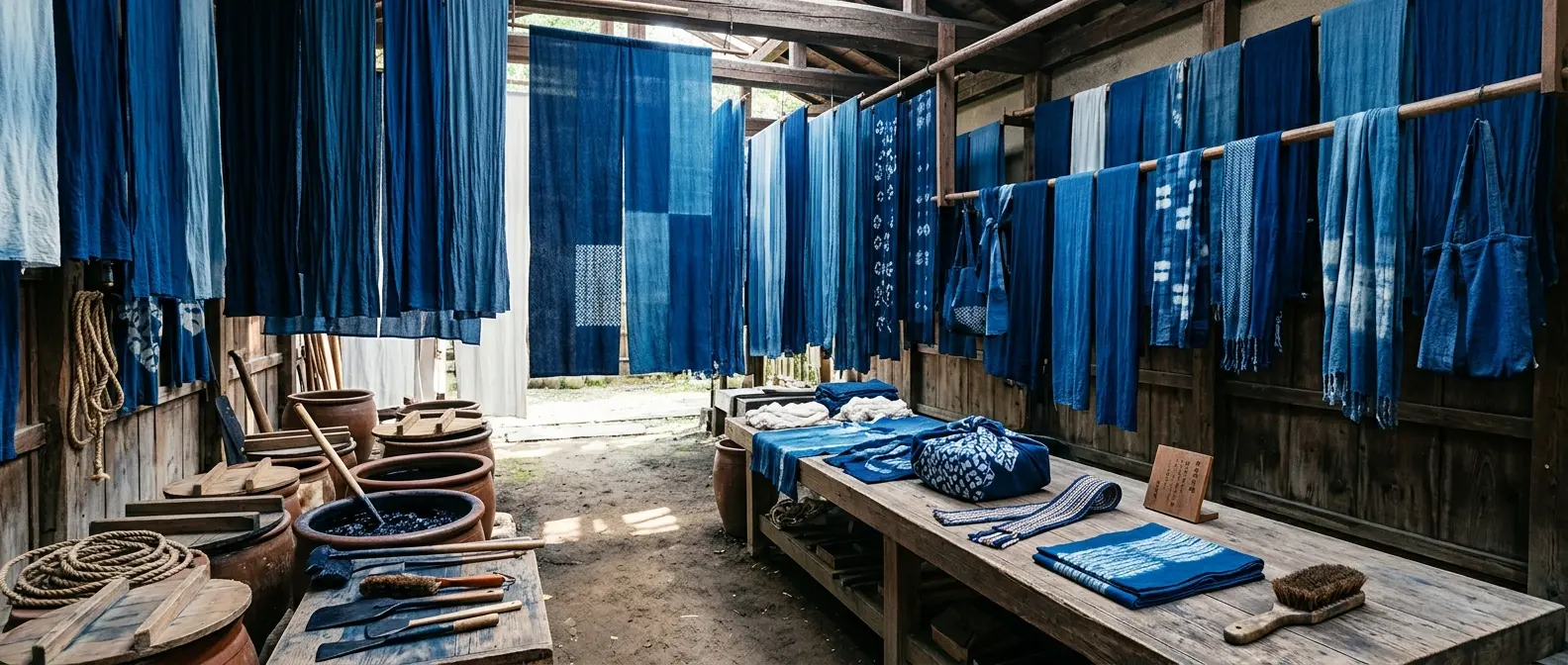
Among Japan’s traditional crafts, textile arts reveal a profound relationship between human creativity, natural materials and the passage of time. From kimono and ceremonial garments to everyday fabrics, Japanese textiles have developed through centuries of refinement, combining technical mastery with a deep appreciation for subtle variations.
Rather than focusing only on decoration, traditional Japanese textile arts often emphasise the qualities of the material itself. The texture of the fibre, the rhythm of repeated patterns and the gradual transformation created through dyeing are considered essential parts of the final work.
Among the many techniques that define Japanese textiles, indigo dyeing (aizome, 藍染) occupies a particularly important place. Its deep blue tones, created through a patient process of repeated immersion, have become one of the most recognisable expressions of Japanese craftsmanship.
Demo Content Notice
Every article on this website is created to showcase the design features and content possibilities of this WordPress theme. The content about Japan is provided for illustrative purposes, may include simplified descriptions or minor inaccuracies, and should not be considered a substitute for official or authoritative sources.
Natural Fibres and Traditional Knowledge
The history of Japanese textiles is closely connected to the use of natural fibres. Silk, cotton, hemp and other plant-based materials were selected not only for their practical qualities, but also for their ability to interact with dyes and techniques.
Silk became associated with refined garments and formal clothing, especially within the traditions of the kimono. Hemp and other durable fibres were widely used for everyday fabrics, particularly in rural communities where local materials shaped regional textile traditions.
The production of textiles required knowledge passed down through generations: growing or preparing fibres, spinning thread, weaving fabrics and applying decorative techniques. Each stage demanded patience and precision.
This approach created a culture where textiles were not simply manufactured objects, but the result of a long relationship between people, materials and local environments.
Indigo Dyeing: The Many Shades of Blue
Japanese indigo dyeing is based on ai (藍), the Japanese indigo plant. Through fermentation and careful preparation, the leaves are transformed into a dye known as sukumo, which becomes the foundation of the traditional dyeing process.
The characteristic blue of aizome is not achieved in a single step. Fabric is repeatedly immersed in the dye bath, removed, exposed to air and allowed to oxidise before being dyed again.
With each repetition, the colour becomes deeper and richer. The artisan controls the process through experience, deciding how many immersions are needed to achieve the desired tone.
This creates a unique relationship between time and colour. The final shade is not simply selected from a palette, but gradually developed through a sequence of actions.
The result is a material that carries visible evidence of its creation, much like the marks left by fire on Japanese ceramics or the grain revealed in traditional woodworking.
Shibori: Patterns Created Through Resistance
One of the most distinctive textile techniques associated with indigo dyeing is shibori (絞り), a method of creating patterns by preventing certain areas of fabric from absorbing dye.
Before immersion, the textile is folded, twisted, stitched, compressed or tied. These protected areas remain lighter, creating complex patterns once the fabric is dyed.
Shibori demonstrates a creative principle often found in Japanese arts: beauty can emerge from limitation.
Instead of adding decoration directly onto the surface, the artisan works by controlling what the dye cannot reach. The final pattern is created through the interaction between preparation, material and chance.
Because each piece depends on the exact folding, binding and dyeing process, no two textiles are completely identical.
The Aesthetic of Subtle Variation
Japanese textile traditions often value nuance rather than visual excess.
The appreciation of subtle differences can be seen in the many shades of indigo, from pale blue to deep almost-black tones. These variations allow the material itself to become expressive.
A fabric dyed many times may reveal differences caused by the movement of the artisan’s hands, the condition of the dye bath or the characteristics of the fibre.
This acceptance of variation reflects a broader Japanese aesthetic approach, where traces of process and individuality contribute to the beauty of an object.
A handmade textile does not hide the effort behind its creation. Instead, the marks of time and labour become part of its identity.
Textiles in Everyday Life and Culture
Although some traditional textiles are associated with formal clothing and ceremonies, fabric has always been deeply connected to everyday Japanese life.
The kimono represents one of the most recognisable examples, combining craftsmanship, seasonal awareness and symbolic meaning. The choice of colours, patterns and materials could communicate social status, occasion and connection with the natural world.
Beyond clothing, textile techniques have also been applied to household objects, accessories and practical items. Fabrics carried the knowledge of communities, reflecting regional styles and local resources.
In this sense, textile arts were not separated from ordinary life. They were part of the daily environment, bringing beauty and craftsmanship into functional objects.
Preserving Tradition Through Innovation
Today, Japanese textile artists continue to explore traditional methods while adapting them to contemporary contexts.
Some artisans preserve historical techniques exactly as they have been transmitted through generations. Others combine traditional dyeing and weaving methods with modern design, creating textiles that respond to contemporary fashion, interiors and artistic expression.
This balance between preservation and experimentation allows textile traditions to remain active rather than becoming simple historical references.
The value of techniques such as indigo dyeing does not come only from their age, but from their ability to continue inspiring new interpretations.
A Living Relationship Between Hands and Materials
Japanese textile arts demonstrate that craftsmanship is not only about producing beautiful objects. It is about developing a relationship with materials through knowledge, patience and attention.
The creation of a dyed fabric involves countless small decisions: preparing the fibre, controlling the colour, repeating the process and accepting the variations that emerge along the way.
Like washi, ceramics and woodworking, textiles reveal a recurring theme in Japanese craftsmanship: beauty appears when human skill works together with the natural characteristics of a material.
Through fibres, patterns and shades of indigo, Japanese textile traditions preserve the memory of countless gestures. Each piece becomes more than a surface or a decoration; it becomes a record of time, care and human connection.