
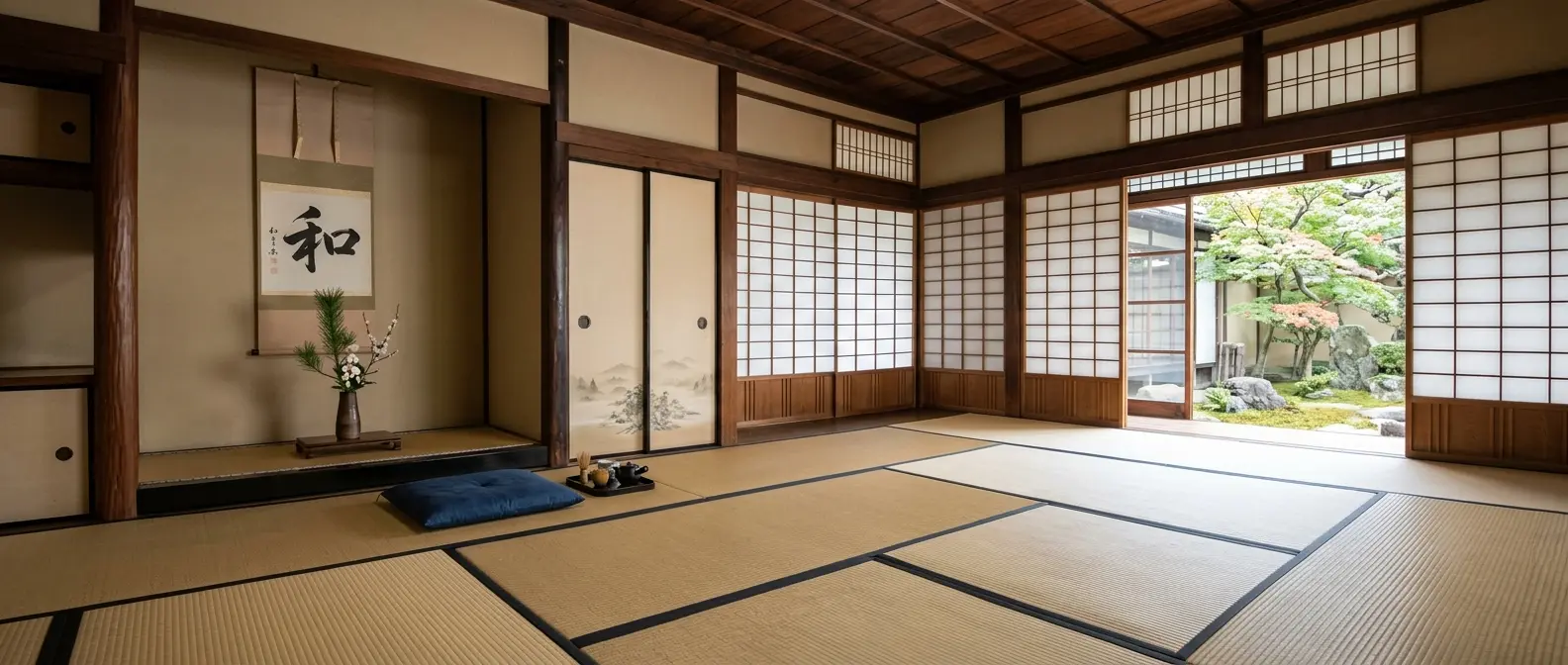
Minimalism is often associated with the idea of owning fewer things, reducing possessions and creating simpler spaces. Yet in Japan, the appreciation of simplicity has deeper cultural roots. It is not only about removing what is unnecessary, but about understanding the relationship between objects, spaces and the people who use them.
From traditional architecture to everyday rituals, Japanese aesthetics have long valued balance, restraint and awareness. A room does not become meaningful because it is filled with decorations, but because every element has a purpose. An object is not appreciated only for its function, but also for the attention, craftsmanship and history it represents.
This approach does not define simplicity as emptiness. Instead, it suggests that leaving space — physical, visual and mental — allows what truly matters to become more visible.
The Meaning of Simplicity
The Japanese appreciation of simplicity can be found across many traditional arts, including tea ceremony, garden design, calligraphy and architecture. In each of these disciplines, beauty often emerges through careful limitation rather than abundance.
The tea room is one of the clearest examples of this philosophy. The space is intentionally restrained, with natural materials, limited decoration and carefully chosen objects. A single flower arrangement or a particular tea bowl can receive attention precisely because the surrounding environment does not compete with it.
This principle reflects a broader idea: simplicity is not the absence of refinement, but the result of thoughtful selection. Removing unnecessary elements requires understanding what gives meaning to an experience.
In this sense, Japanese minimalism is less about having less and more about creating harmony between what remains.
Ma: The Beauty of Empty Space
One of the most important concepts connected with Japanese aesthetics is ma (間), often translated as “space”, “interval” or “pause”. Rather than representing emptiness, ma describes the meaningful relationship between elements.
In architecture, an empty area allows movement and light to enter a space. In music, silence gives rhythm its structure. In calligraphy, the untouched areas around the characters are essential parts of the composition.
The same principle can be applied to everyday life. A room with open space allows objects to be appreciated individually. A moment of silence allows thoughts to settle. A pause between activities creates awareness rather than simply leaving unused time.
Ma suggests that what is absent can be just as important as what is present.
This understanding has influenced Japanese design for centuries, where balance is often created not by adding more elements, but by carefully considering the relationship between them.
Wabi-Sabi and the Beauty of Imperfection
Another concept closely associated with Japanese aesthetics is wabi-sabi, an appreciation of imperfection, impermanence and the traces left by time.
A handmade ceramic bowl with an irregular shape, a wooden surface marked by years of use or a garden changing with the seasons can possess a beauty that comes from their uniqueness. Rather than seeking flawless perfection, wabi-sabi recognises value in natural processes and gradual transformation.
This perspective influences the way objects are perceived. A repaired item may become more meaningful because its history is visible. Materials are appreciated not only when they are new, but also when they reveal their relationship with time.
Wabi-sabi does not mean accepting poor quality or neglect. Instead, it represents a different understanding of beauty: one that includes change, simplicity and authenticity.
In everyday life, this can translate into choosing objects carefully, maintaining them with attention and appreciating their character rather than constantly replacing them.
The Japanese Home: Space, Function and Balance
Traditional Japanese homes demonstrate how minimalism can be connected to flexibility and function. Rooms designed with tatami flooring, sliding doors and natural materials were not intended to contain large quantities of furniture. Instead, spaces could adapt according to different activities.
A room might serve as a place for receiving guests during the day and become a sleeping area at night. Objects were often stored away when not needed, allowing the space itself to change.
The use of shōji screens, wooden elements and simple materials created environments where light, texture and seasonal changes became part of the experience.
This approach differs from the idea that a home must display possessions to express identity. Instead, the environment becomes a quiet background that allows daily activities and human relationships to take priority.
Contemporary Japanese interiors often continue to reflect this relationship between simplicity and function, combining modern design with traditional principles of balance and restraint.
Objects with Meaning
Minimalism in Japanese culture is not defined only by empty spaces, but also by the relationship people establish with the objects that surround them.
Traditional Japanese objects often reveal a balance between usefulness, craftsmanship and simplicity. A tea bowl, a wooden tray or a handmade textile may appear modest in appearance, yet their value comes from the materials, the skill behind their creation and the attention they receive through daily use.
This approach differs from the idea that possessions should simply be reduced. The question is not how many objects a person owns, but whether those objects contribute meaning, beauty or purpose to everyday life.
Care and maintenance are also important parts of this relationship. Repairing an item, preserving its condition and allowing it to age naturally reflect the idea that objects can accumulate history rather than becoming disposable.
This perspective can be seen in many Japanese crafts, where small variations and traces of human work are considered part of an object’s character. The handmade surface of a ceramic piece, the texture of natural materials or the marks created through years of use are not imperfections to eliminate, but elements that connect objects to time and experience.
In this way, Japanese minimalism is not a rejection of material things. It is an invitation to develop a more conscious relationship with them, choosing fewer objects but appreciating them more deeply.
From Tradition to Contemporary Design
The influence of Japanese minimalism extends far beyond Japan. Architects, designers and creative professionals around the world have been inspired by ideas such as simplicity, natural materials and careful attention to detail.
However, Japanese minimalism is not simply a visual style characterised by neutral colours and empty rooms. Its deeper principle is the relationship between form and purpose.
A well-designed object is not valuable because it is minimal in appearance, but because every aspect of it has been considered. A space is not peaceful because it contains nothing, but because each element contributes to the overall atmosphere.
This approach can be seen in contemporary fields ranging from architecture and product design to typography and digital interfaces, where clarity and restraint often improve the relationship between people and their surroundings.
The global popularity of Japanese-inspired minimalism shows the lasting influence of these ideas, but also creates the risk of reducing them to a superficial aesthetic. The cultural foundations behind simplicity are not about creating empty environments; they are about creating meaningful ones.
A Different Way of Paying Attention
Minimalism in everyday Japanese life is ultimately connected with awareness. It encourages people to notice details that are easily overlooked: the texture of a material, the changing light in a room, the beauty of an object used for many years.
Rather than focusing only on possession or consumption, this perspective invites a different relationship with the things around us. Objects become part of a larger environment, and spaces become places where experiences unfold.
In a world often defined by speed and excess, the Japanese approach to simplicity offers another possibility: not escaping from the material world, but engaging with it more carefully.
Minimalism is therefore not only about having fewer things. It is about understanding what deserves attention.