
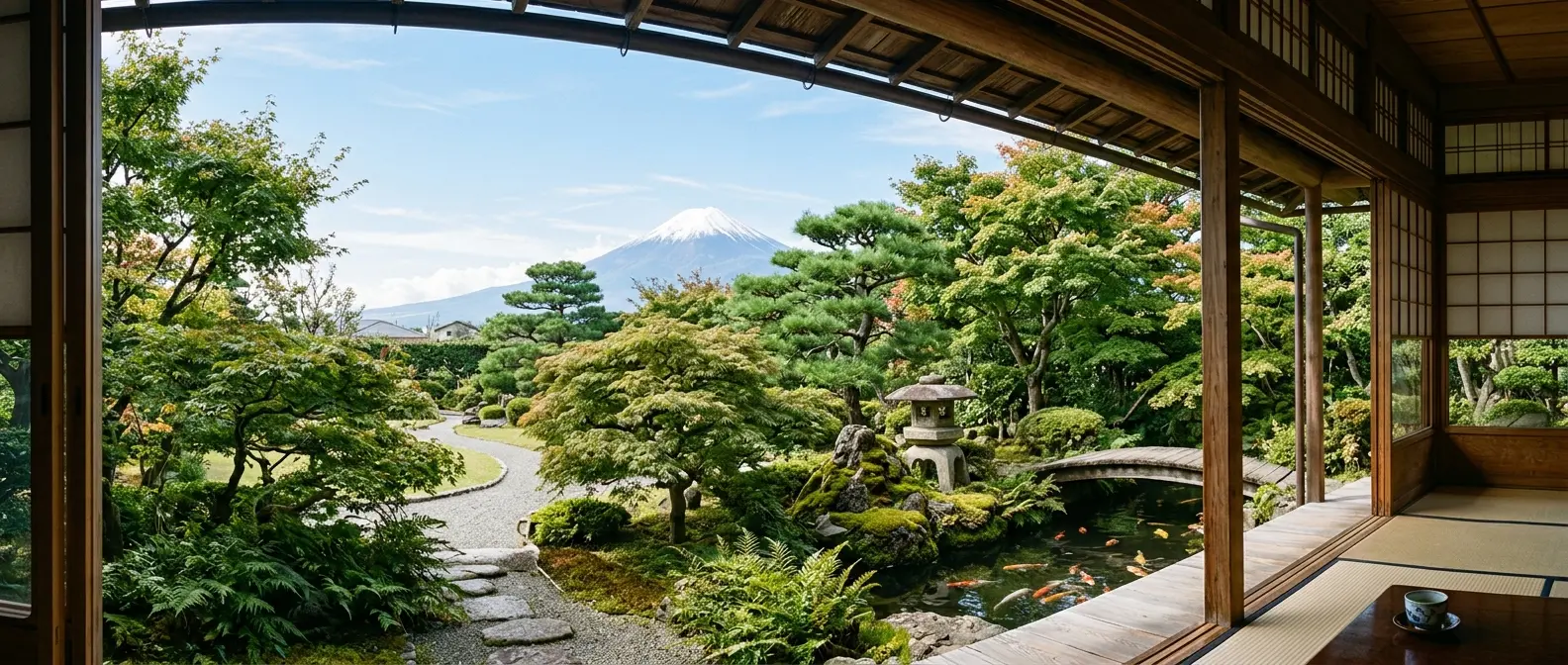
A Japanese garden is rarely designed as an isolated space. Beyond its walls, fences or carefully placed boundaries, the surrounding landscape often becomes part of the composition itself. A distant mountain, a line of trees or even the silhouette of a temple roof may appear to belong naturally to the garden, extending its visual and emotional space beyond its physical limits.
This approach is known as shakkei (借景), often translated as “borrowed scenery”. Rather than creating a landscape completely separated from its surroundings, the garden incorporates external elements into its design, transforming the relationship between human-made space and the wider environment.
Through shakkei, the garden does not simply display nature. It enters into a dialogue with it.
Demo Content Notice
Every article on this website is created to showcase the design features and content possibilities of this WordPress theme. The content about Japan is provided for illustrative purposes, may include simplified descriptions or minor inaccuracies, and should not be considered a substitute for official or authoritative sources.
Beyond the Garden Boundary
The idea of borrowed scenery developed from a broader Japanese appreciation for continuity between designed spaces and the natural world. Traditional gardens often avoid clear visual separation between the cultivated landscape and the environment beyond it, allowing distant elements to become part of the overall composition.
A mountain range behind a garden, a forest visible through carefully positioned openings or the changing colours of surrounding vegetation can all contribute to the experience of the space. These elements are not physically part of the garden, yet they influence its atmosphere as strongly as the stones, plants and pathways within it.
The boundary of the garden becomes less a barrier and more a frame that directs attention toward a larger landscape.
The Art of Seeing More
Shakkei requires careful observation and deliberate design. Garden creators consider not only what exists within the garden itself, but also how external features appear from specific viewpoints.
The position of trees, buildings, walls and pathways can guide the visitor’s gaze toward selected elements of the surrounding scenery. A distant mountain may appear as a natural backdrop, while a nearby tree or architectural feature may create a sense of depth and connection.
This technique demonstrates that Japanese garden design is not only about adding elements, but also about understanding relationships between them. What is left outside the garden can be just as important as what is placed inside.
Famous Examples of Borrowed Scenery
One of the most celebrated examples of shakkei can be found at Entsū-ji Temple in Kyoto, where the distant shape of Mount Hiei is incorporated into the garden view. Created during the seventeenth century, the garden was designed around the mountain’s silhouette, carefully framed by vegetation and other elements within the composition.
Although the mountain lies several kilometres away and is not part of the temple grounds, it becomes an essential element of the landscape experienced by visitors. The garden does not simply present a view of Mount Hiei; it establishes a relationship between human design and the existing environment.
This relationship reflects a broader principle of Japanese garden aesthetics: meaning can emerge not only from elements created within a space, but also from the way that space connects with what already exists around it.
Other gardens throughout Japan use similar principles, incorporating forests, hills or coastal landscapes into their compositions. Each example depends on its unique surroundings, making shakkei impossible to reproduce in exactly the same way elsewhere.
The borrowed landscape is not simply an attractive background. It gives the garden a sense of place and connects it to the geography of the region.

Expanding the Meaning of Space
The principle of shakkei reveals a different understanding of boundaries. Instead of defining a garden only through what it contains, it also considers what exists beyond its limits.
This idea reflects a recurring characteristic of Japanese aesthetics: meaning often emerges through relationships rather than isolated objects. A garden is not only a collection of stones, plants and structures; it is an arrangement of connections between natural elements, human intention and the passing seasons.
In this sense, borrowed scenery expands the garden without physically enlarging it. A limited space can suggest something much greater, inviting visitors to perceive the landscape as an interconnected whole.
A Lesson for Contemporary Design
The influence of shakkei extends beyond traditional gardens. Its principles can be recognised in modern architecture and landscape design, where views, surroundings and natural features are considered essential parts of a space.
The idea that a building or garden should respond to its environment remains relevant in contemporary design. Instead of treating the outside world as something separate, shakkei suggests that meaningful spaces are created through dialogue with their surroundings.
A garden does not need to contain everything to feel complete. Sometimes its greatest beauty comes from what it allows us to see beyond itself.