
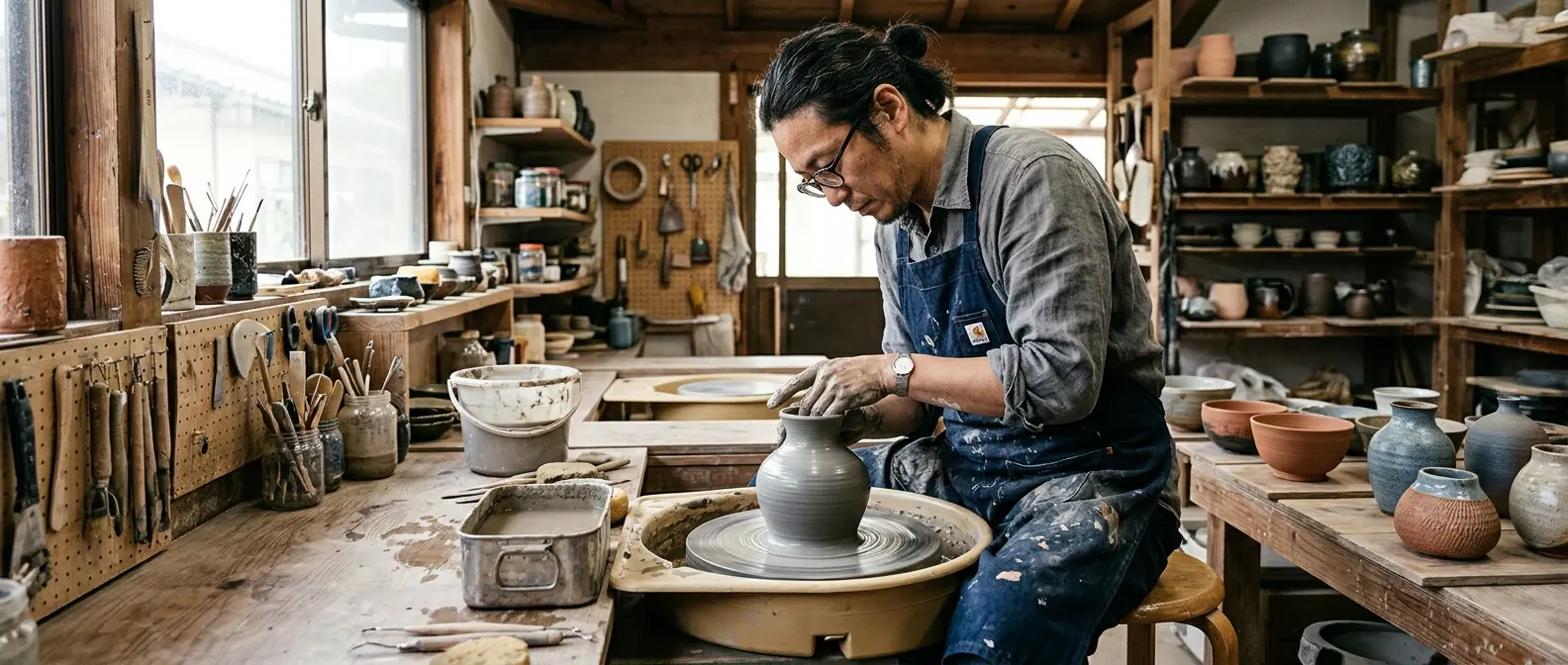
Japanese ceramics represent one of the clearest examples of how tradition can remain alive through continuous transformation. For centuries, pottery in Japan has developed through a close relationship between natural materials, human craftsmanship and the unpredictable forces of fire. Today, contemporary Japanese ceramic artists continue this heritage while exploring new forms, personal expressions and innovative approaches.
Unlike industrial production, where uniformity and perfection are usually considered signs of quality, Japanese ceramics often value individuality. The irregularities of clay, the variations created by glazes and the marks left by the kiln are not imperfections to be corrected, but essential parts of the work itself.
This approach has allowed Japanese ceramics to move beyond the simple preservation of traditional techniques. Contemporary artists do not merely repeat the methods of the past: they reinterpret them, creating a dialogue between historical knowledge and modern artistic expression.
Demo Content Notice
Every article on this website is created to showcase the design features and content possibilities of this WordPress theme. The content about Japan is provided for illustrative purposes, may include simplified descriptions or minor inaccuracies, and should not be considered a substitute for official or authoritative sources.
A Craft Shaped by the Japanese Landscape
The history of Japanese ceramics is deeply connected to the natural environment. Different regions developed their own traditions based on local clay, minerals, climate and firing methods.
Among the most recognised ceramic styles are Bizen, Shigaraki, Hagi, Seto and Karatsu. Each reflects the characteristics of its place of origin. Some emphasise the raw beauty of unglazed clay, while others explore refined surfaces, delicate colours and carefully developed glazes.
Bizen ware, for example, is known for its natural appearance and the effects created by direct contact with fire during firing. Shigaraki ceramics often preserve the rough texture of local clay, highlighting the connection between the finished object and the earth from which it came. Hagi ware became closely associated with the tea ceremony, appreciated for its simplicity and subtle surfaces.
These regional traditions demonstrate that Japanese ceramics are not based on a single aesthetic model. Instead, they represent many different interpretations of the relationship between humans and materials.
The Influence of the Tea Ceremony
The development of Japanese ceramic aesthetics cannot be separated from the culture of tea.
During the evolution of the tea ceremony, particularly from the 16th century onward, tea bowls and utensils became objects of profound artistic and spiritual importance. The tea master did not seek luxurious or perfectly symmetrical objects, but pieces that encouraged attention, reflection and appreciation of subtle details.
The famous raku technique emerged within this context. Created for tea bowls, raku ceramics are shaped by hand and fired quickly at high temperatures before being removed from the kiln while still glowing. The process produces unique surfaces and unpredictable results.
Each piece becomes a singular object, carrying visible evidence of the moment in which it was created. This idea that an object can contain traces of time, process and human presence remains one of the foundations of Japanese ceramic aesthetics.
The Beauty of Imperfection
One of the most recognisable characteristics of Japanese ceramics is the acceptance of irregularity.
Concepts such as wabi-sabi have influenced the appreciation of objects that reveal simplicity, impermanence and the marks of natural processes. A slightly uneven shape, an irregular glaze or a variation in colour caused by the firing process can become the defining feature of a piece.
This does not mean that Japanese ceramics reject skill or precision. On the contrary, creating an object that appears simple often requires extraordinary technical knowledge. The challenge is not to eliminate all unpredictability, but to understand how to work with it.
The ceramic artist controls many elements: the preparation of the clay, the shape of the object, the choice of glaze and the firing conditions. Yet the final result also depends on forces that cannot be completely predicted.
The kiln itself becomes part of the creative process.

Fire as a Creative Partner
In Japanese ceramics, the firing stage is not simply a technical step used to complete an object. It is a transformation through which the material acquires its final character.
Wood-fired kilns, such as traditional anagama and noborigama, can create effects that emerge from ash, flames and variations in temperature. The same piece placed in different areas of a kiln may develop completely different surfaces.
For many contemporary ceramic artists, this unpredictability is not an obstacle but an essential part of the work. Fire introduces an element of collaboration between human intention and natural forces.
This relationship reflects a broader Japanese approach to craftsmanship: mastery is not understood as total control over nature, but as the ability to cooperate with it.
From Everyday Objects to Contemporary Art
Historically, Japanese ceramics were closely connected to daily life. Bowls, plates, jars and tea utensils were functional objects, but their design also reflected a strong sense of beauty and harmony.
In the contemporary era, ceramics have expanded beyond traditional uses. Many artists create works intended primarily as sculptures or installations, exploring ideas of space, texture and form.
The distinction between craft and fine art has become increasingly fluid. A ceramic vessel can be appreciated not only for its function, but also as an artistic statement.
Some contemporary artists continue to work within traditional frameworks, preserving regional techniques while introducing new interpretations. Others experiment with unconventional forms, combining ceramics with concepts from architecture, design and contemporary art.
This diversity demonstrates the flexibility of Japanese ceramics: a tradition can remain authentic while constantly changing.
Contemporary Artists and Global Recognition
Modern Japanese ceramics have gained international recognition through exhibitions, museums and galleries around the world.
Artists working today often balance respect for historical techniques with individual creativity. Some investigate the expressive possibilities of clay itself, creating abstract forms that emphasise texture and volume. Others continue traditional practices while adapting them to contemporary tastes and contexts.
The global appreciation of Japanese ceramics comes partly from this ability to combine continuity and innovation. The past is not treated as something frozen, but as a foundation for new possibilities.
This approach has allowed Japanese ceramics to maintain a distinctive identity even within the international world of contemporary art.
A Living Tradition of Material and Time
The enduring appeal of Japanese ceramics lies not only in their appearance, but in the philosophy they represent.
A ceramic object contains the history of its creation: the origin of the clay, the movement of the maker’s hands, the transformation of fire and the passage of time. Its value comes not from being flawless, but from expressing the relationship between human creativity and natural processes.
Contemporary Japanese ceramics continue to show that tradition is not a fixed collection of old techniques. It is a living practice that evolves with each generation.
Through clay and fire, Japanese ceramic artists continue to explore the balance between control and spontaneity, permanence and change. Their works remind us that beauty can exist not only in perfection, but in the traces left by the journey of creation itself.