
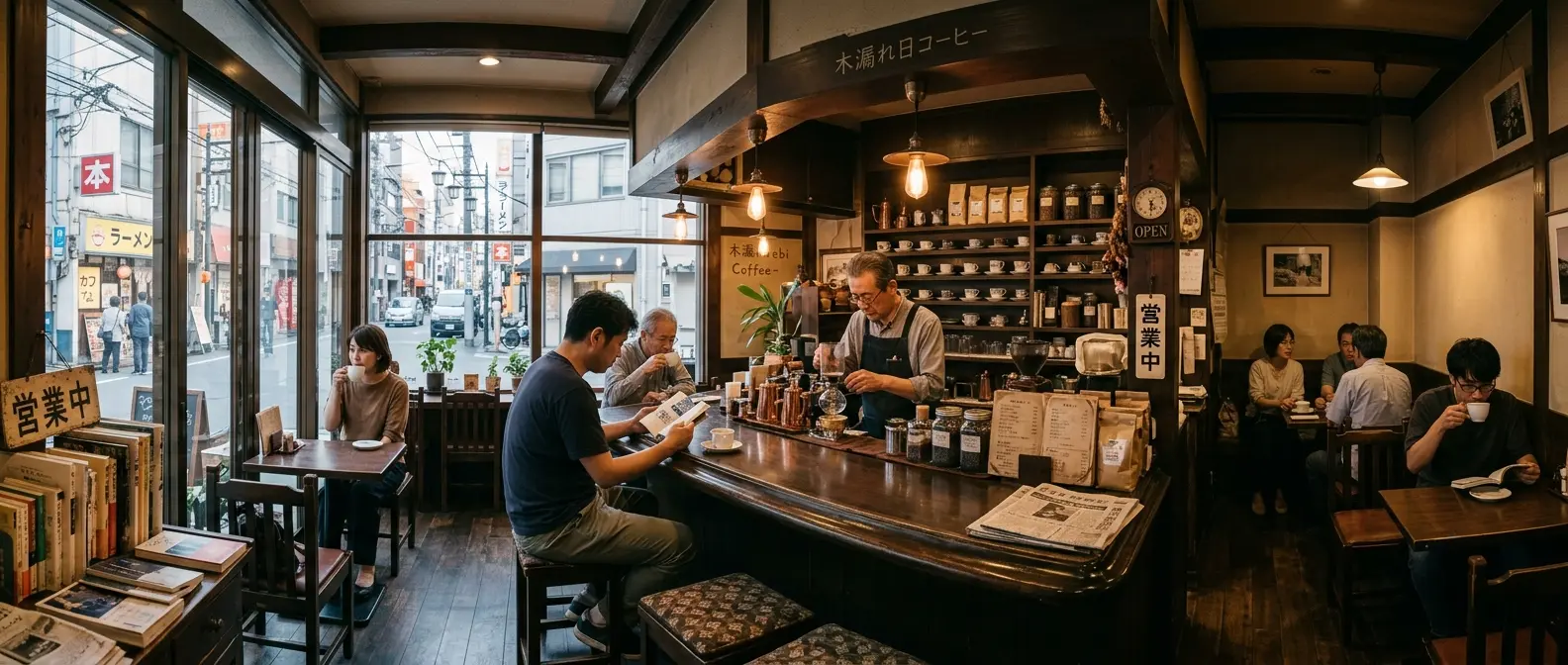
In Japanese cities, small cafés are more than places to drink coffee. They are spaces where people slow down, spend time alone or share quiet moments with others. Away from the speed of crowded streets and busy stations, these places offer a different rhythm of urban life.
From traditional kissaten (喫茶店) to modern independent cafés, these small spaces reflect a particular approach to hospitality: attention to atmosphere, careful design and respect for the experience of the guest.
Rather than being defined only by what they serve, many Japanese cafés are valued for the feeling they create.
Demo Content Notice
Every article on this website is created to showcase the design features and content possibilities of this WordPress theme. The content about Japan is provided for illustrative purposes, may include simplified descriptions or minor inaccuracies, and should not be considered a substitute for official or authoritative sources.
The World of Kissaten
The traditional kissaten emerged in Japan during the early twentieth century as places dedicated to coffee, conversation and cultural exchange. Unlike ordinary cafés, many were designed as refined spaces where customers could spend time reading, listening to music or meeting others.
Some kissaten developed distinctive identities through their interiors: wooden furniture, soft lighting, carefully arranged objects and a quiet atmosphere that encouraged visitors to remain for longer periods.
For many customers, the appeal of a kissaten is not simply the coffee itself, but the sense of entering a different environment where time seems to move more slowly.
Spaces Designed for Presence
One of the defining characteristics of small Japanese cafés is the attention given to the relationship between space and experience.
A small counter, a carefully chosen piece of furniture or the arrangement of light entering through a window can influence the entire atmosphere of a café. Owners often design their spaces with a strong personal vision, creating places that reflect their own values and aesthetic preferences.
This attention to detail is connected with a broader Japanese appreciation for harmony and balance. The environment is not treated as a simple background, but as an essential part of the experience.
Cafés as Urban Retreats
In large cities such as Tokyo and Osaka, cafés often provide a temporary escape from the intensity of urban life.
A customer may visit alone, spending time reading, writing, studying or simply observing the surroundings. Unlike many social spaces that encourage quick visits, small cafés often invite people to pause.
This does not mean they are isolated places. Many cafés become familiar meeting points for local communities, where regular customers develop relationships with the owners and with each other.
The connection between café and neighbourhood is often built through repetition: the same seat, the same greeting, the same small rituals repeated over time.
From Traditional Kissaten to Modern Cafés
While traditional kissaten remain an important part of Japanese café culture, new generations of cafés have introduced different approaches.
Independent coffee shops, specialty cafés and creative spaces have appeared in many urban areas, combining international influences with local sensibilities. Some focus on carefully prepared coffee, others on minimalist interiors, books, music or community events.
Despite these differences, many modern cafés share something with older kissaten: the idea that a café should offer an experience, not only a product.
The emphasis remains on creating a meaningful relationship between people, objects and space.
The Personal Character of Small Cafés
Unlike large chains, many independent cafés are shaped by the personality of their owners. The choice of furniture, music, decoration and menu often reflects a personal story or a particular vision.
This individuality is part of their charm. Each café becomes a small expression of creativity within the larger urban environment.
For visitors, discovering these places can reveal another side of Japanese cities: one made not only of skyscrapers and crowded streets, but also of quiet corners where personal connections and traditions continue.
A Different Rhythm of Urban Life
Small cafés represent an important aspect of everyday culture in Japan. They show that urban spaces can also provide moments of calm, reflection and human connection.
In a society often associated with efficiency and speed, these places preserve the value of taking time. A cup of coffee, a familiar room and a quiet conversation can become simple but meaningful experiences.
Through kissaten and independent cafés, Japanese cities reveal a different dimension of urban life: one where atmosphere, hospitality and attention to detail remain at the centre.