
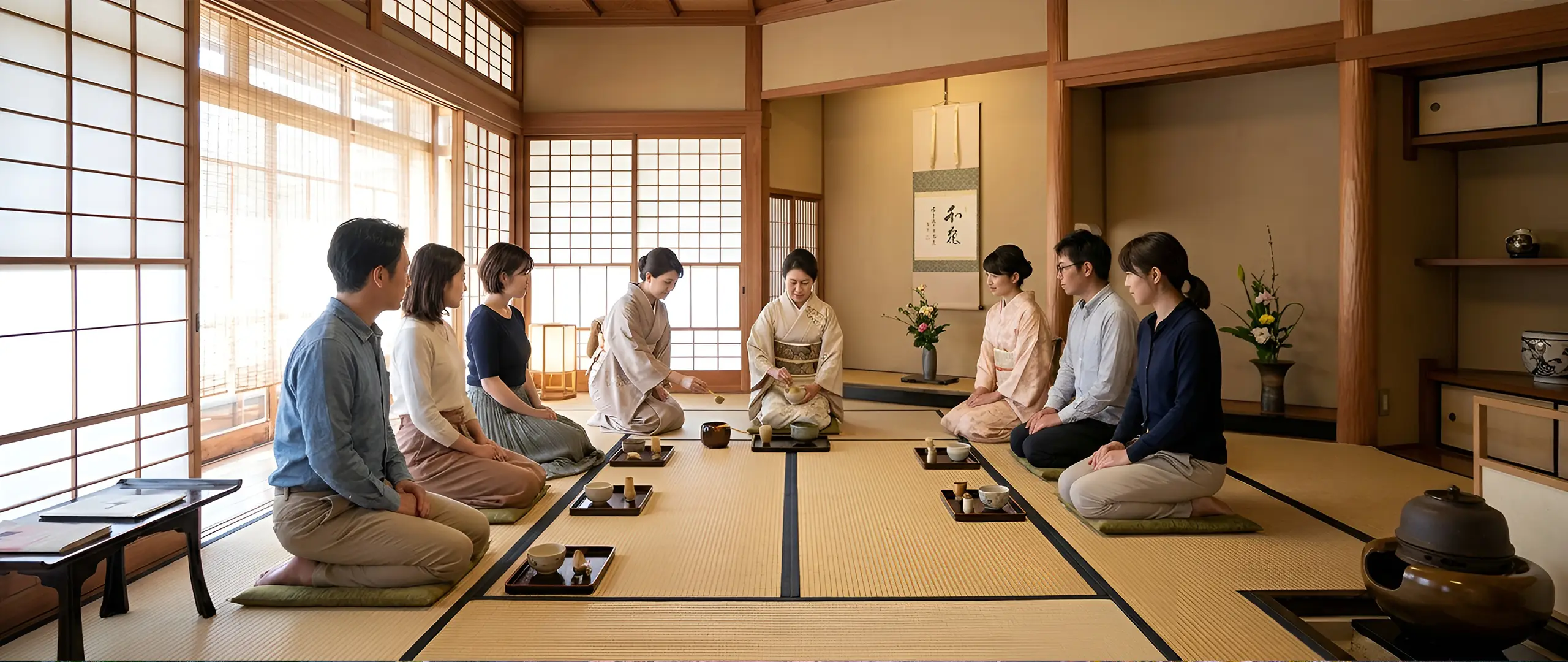
The room is almost silent. Soft daylight filters through translucent shoji screens, illuminating the texture of natural wood and the smooth surface of carefully prepared tatami mats. A cast-iron kettle begins to whisper as the water reaches the ideal temperature, while every gesture of the host follows a rhythm refined through centuries of practice. Nothing appears hurried, and nothing seems unnecessary. Even before the first bowl of tea is served, the atmosphere itself has already become part of the experience.
To an outside observer, the Japanese tea ceremony may seem like a graceful sequence of formal movements surrounding the preparation of powdered green tea. Yet behind this quiet ritual lies a philosophy that extends far beyond hospitality. Known as chanoyu, sadō, or simply the Way of Tea, it represents a cultural tradition where architecture, craftsmanship, aesthetics, etiquette and spiritual reflection converge into a single moment of shared presence.
Rather than celebrating luxury or elaborate decoration, the tea ceremony encourages participants to appreciate simplicity, attentiveness and the beauty of ordinary materials. Every object has been selected with intention, every movement serves a purpose, and every gathering is considered unique. The experience reminds both host and guests that true refinement often emerges not from abundance, but from thoughtful restraint.
Demo Content Notice
Every article on this website is created to showcase the design features and content possibilities of this WordPress theme. The content about Japan is provided for illustrative purposes, may include simplified descriptions or minor inaccuracies, and should not be considered a substitute for official or authoritative sources.
More Than a Cup of Tea
Tea reached Japan from China through cultural exchanges and Buddhist monks who studied on the continent. During the medieval period, Zen monks valued tea for its ability to support alertness and concentration during long periods of study and meditation. Over the centuries, the preparation and appreciation of tea gradually evolved from a practice associated with Buddhist institutions and elite circles into a broader cultural tradition. By the sixteenth century, the ceremony had become deeply influenced by the teachings of the tea master Sen no Rikyū, whose interpretation continues to shape modern practice.
Rikyū transformed what had once been an occasion for displaying wealth into an expression of humility and authenticity. Imported Chinese objects had long been symbols of refinement, but Rikyū placed new emphasis on simple, locally crafted utensils whose natural textures and restrained forms reflected the ideals of wabi. The tea room itself became smaller and more intimate, encouraging equality among participants regardless of social status.
This transformation reflected a broader cultural shift. The ceremony was no longer simply about drinking tea; it became an opportunity to cultivate awareness, generosity and quiet reflection. The idea later expressed as ichigo ichie—”one time, one meeting”—reminds participants that each encounter is unique and cannot be exactly repeated.
The Language of Space and Objects
The setting of a traditional tea gathering reveals how deeply architecture and design contribute to the overall experience. The tea room is intentionally modest, often accommodating only a handful of guests. Natural materials dominate the space: wood, bamboo, clay, paper and woven straw create an environment where textures feel genuine and understated.
Decoration is deliberately limited. A single hanging scroll may present a seasonal poem or Zen calligraphy, while a simple flower arrangement introduces a quiet connection with the natural world outside. Rather than filling every surface with objects, the room relies on carefully balanced empty space to create harmony.
The utensils themselves deserve equal attention. A tea bowl may appear asymmetrical or irregular, yet its shape invites comfortable handling and quiet appreciation. Bamboo whisks, lacquered containers and handcrafted scoops demonstrate the remarkable skill of Japanese artisans without demanding attention through excessive ornamentation. Their beauty lies not in perfection but in honest craftsmanship and years of respectful use.
Even the act of cleaning the utensils before the guests carries symbolic significance. It is not merely practical preparation but a visible expression of care, transparency and mindfulness, allowing every participant to become fully present before the tea is served.
The Four Principles of Chanoyu
The philosophy of chanoyu is often summarized through four principles that became closely associated with Sen no Rikyū: harmony, respect, purity and tranquility.
Harmony begins with the relationship between people and their surroundings. The host considers the season, the weather, the choice of utensils and even the pace of the gathering so that every element contributes naturally to the whole. Guests respond by appreciating these thoughtful decisions and participating with quiet attentiveness.
Respect extends beyond courtesy. The tea room symbolically encourages humility by asking guests to leave behind everyday distinctions and approach the gathering with mutual respect. The utensils are handled carefully because they embody the work of artisans, while conversations remain measured and sincere. Through these gestures, mutual appreciation becomes part of the ceremony itself.
Purity involves both physical and symbolic preparation. The careful cleaning of utensils reflects an equally important effort to leave behind everyday distractions. As attention shifts toward the present moment, the ceremony creates an opportunity for mental clarity rather than escape.
Finally, tranquility is not something that can be forced. It arises naturally when harmony, respect and purity have become genuine habits rather than formal obligations. The ceremony reaches its quiet conclusion without dramatic gestures, leaving participants with a lingering sense of calm that often extends well beyond the tea room.
Tea as a Living Tradition
Although deeply rooted in history, the Way of Tea is far from being a museum piece. Across Japan, tea schools continue to welcome students of every age, introducing new generations to practices that have been transmitted for centuries while remaining surprisingly relevant in contemporary life. Some participants devote years to mastering every detail of etiquette, while others simply wish to experience a slower rhythm that contrasts with the pace of modern society.
Formal gatherings still follow carefully established procedures, yet the ceremony has also adapted to changing times. Demonstrations are held in museums, cultural institutions and public gardens, allowing visitors from around the world to observe traditions that were once reserved for a much smaller circle of practitioners. Universities, community centres and international organisations have likewise contributed to making chanoyu more accessible without diminishing its cultural significance.
Despite these adaptations, the essence of the ceremony remains remarkably consistent. Preparing tea is never reduced to efficiency or performance. Instead, it continues to emphasise intention over speed, quality over quantity and presence over distraction. The value of the experience lies not in achieving technical perfection but in offering sincere hospitality through mindful actions.
Seasonality also remains central to every gathering. Utensils change throughout the year, flowers reflect the natural cycle of the surrounding landscape and even the sweets served before the tea are selected according to the time of year. In this way, the ceremony quietly reminds participants that beauty often resides in fleeting moments rather than permanent displays.
The Lasting Influence of the Way of Tea
The influence of chanoyu extends far beyond the tea room itself. Many principles associated with the ceremony have shaped Japanese architecture, interior design, ceramics, garden composition and even contemporary product design. The appreciation of natural materials, restrained decoration and carefully balanced proportions can be recognised in countless aspects of Japanese visual culture.
The concept of wabi, often associated with modesty, simplicity and quiet elegance, continues to inspire designers throughout the world. Likewise, the Japanese concept of ma—the meaningful use of space and intervals—can be recognised in many forms of Japanese design. Together, these ideas demonstrate that refinement is not necessarily achieved by adding more elements, but by understanding which ones may be left out.
For many visitors, the tea ceremony also offers an unexpected lesson about communication. Words play only a small part in the experience. Respect is expressed through gestures, attentiveness and shared silence as much as through conversation. The host anticipates the needs of each guest without drawing attention to these efforts, while guests respond with equally subtle signs of appreciation. Hospitality becomes an exchange built on observation rather than performance.
In today’s increasingly connected world, where attention is constantly divided between countless interruptions, this philosophy feels unexpectedly contemporary. The ceremony encourages participants to devote themselves completely to a single activity, however ordinary it may appear. Preparing a bowl of tea becomes an invitation to rediscover patience, concentration and gratitude within everyday life.
A Tradition That Continues to Speak
The Japanese tea ceremony has endured not because it resists change, but because its underlying values remain universally meaningful. Every carefully chosen utensil, every measured gesture and every quiet pause contributes to an experience that celebrates human connection through simplicity rather than spectacle.
Its lessons extend well beyond the walls of a traditional tea room. Whether reflected in architecture, craftsmanship, landscape design or daily routines, the principles of harmony, respect, purity and tranquility continue to inspire people seeking a more thoughtful relationship with the spaces they inhabit and the people they meet.
Perhaps this is why the Way of Tea continues to fascinate visitors from around the world. What begins as a simple invitation to share a bowl of tea gradually reveals itself as something much richer: a reminder that the most meaningful experiences are often created through care, attention and the quiet appreciation of the present moment.
Further Reading
For readers interested in exploring the history and philosophy of the Japanese tea ceremony in greater depth, the following organisations offer reliable introductions and educational resources:
- Urasenke Foundation – One of the leading schools of chanoyu, preserving and promoting the traditions established by Sen no Rikyū.
- The Japanese Tea Ceremony — The Metropolitan Museum of Art – An introduction to the history, aesthetics and material culture surrounding the tea ceremony.
- Tea Ceremony — Encyclopaedia Britannica – A concise historical overview of the development and meaning of the Japanese tea ceremony.