
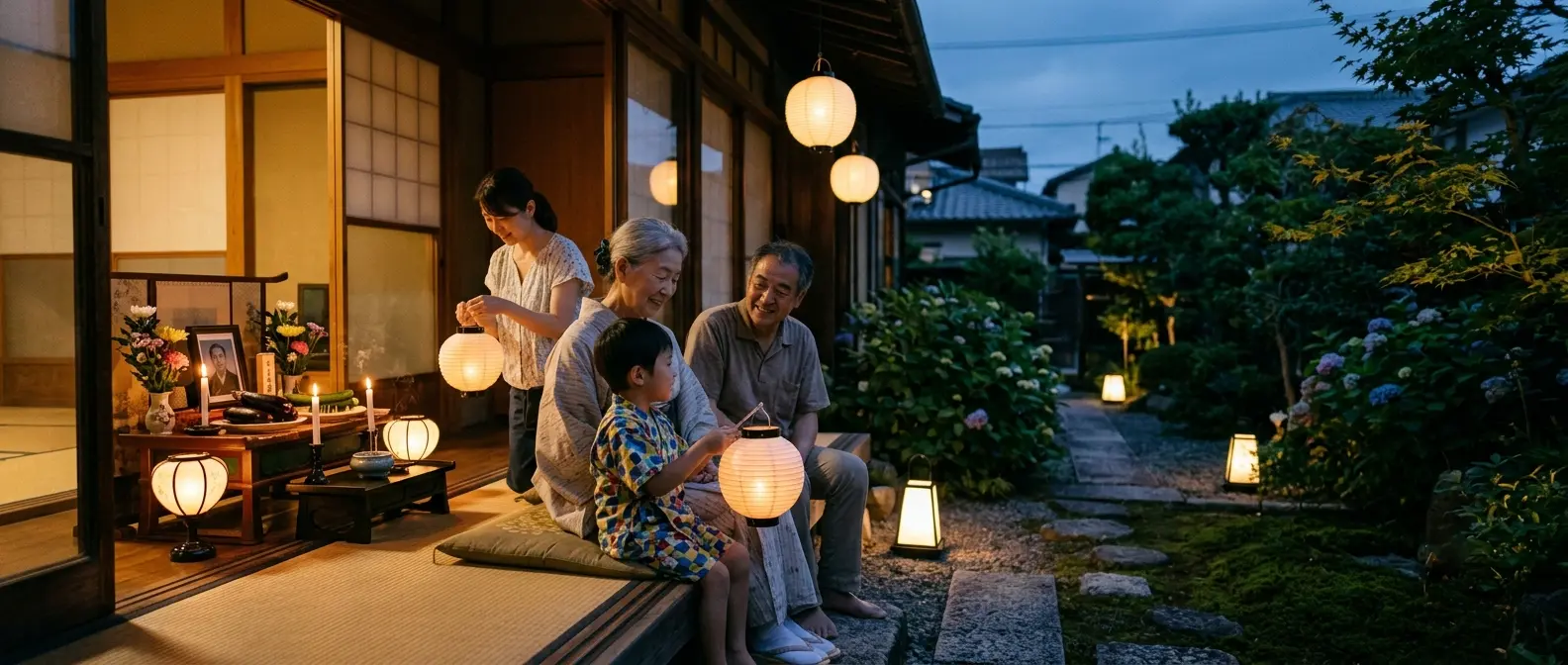
Among Japan’s most important seasonal traditions, Obon (お盆) is a period dedicated to remembering and honouring ancestors. Although often described as a Buddhist custom, Obon has developed over centuries through a combination of Buddhist beliefs, local practices and older traditions connected with respect for family lineage.
During this period, many people return to their hometowns, visit family graves and take part in rituals that express gratitude towards those who came before them. More than a religious observance, Obon is a time when families reconnect, memories are preserved and the relationship between past and present is renewed.
At its heart, Obon expresses a simple but powerful idea: those who came before us continue to be part of our lives.
Demo Content Notice
Every article on this website is created to showcase the design features and content possibilities of this WordPress theme. The content about Japan is provided for illustrative purposes, may include simplified descriptions or minor inaccuracies, and should not be considered a substitute for official or authoritative sources.
Welcoming the Spirits of Ancestors
According to traditional beliefs associated with Obon, the spirits of ancestors return temporarily to the world of the living. Families prepare to welcome them by cleaning graves, offering food and creating spaces of remembrance within their homes.
Many households place offerings near a butsudan (仏壇), a Buddhist altar where family members honour deceased relatives. These offerings may include seasonal fruits, flowers, incense and favourite foods associated with those being remembered.
The preparation itself is meaningful. Cleaning, arranging offerings and visiting ancestral places are not simply acts of ceremony, but ways of maintaining a connection between generations.
The past is not viewed as something separated from everyday life. Instead, ancestors remain part of the family’s continuing story.
Returning Home and Remembering Together
One of the most visible aspects of Obon in modern Japan is the tradition of returning to one’s hometown. Millions of people travel during the Obon period, often making it one of the busiest holiday seasons of the year.
These journeys are not only practical visits to relatives. They represent a return to family roots and to places connected with personal and collective memory.
For many people, Obon is also an opportunity to gather with relatives who may live far away, share meals and remember family members who are no longer present. Through these encounters, the tradition reinforces the importance of family bonds across generations.
Lanterns, Fire and the Journey Between Worlds
Light plays an important symbolic role during Obon.
Many traditions include the use of bon lanterns, which are believed to guide ancestral spirits during their visit. At the beginning of the period, lanterns may symbolically welcome spirits back, while at the end of Obon, lights or floating lanterns are used in some regions to represent their return journey.
One of the best-known examples is tōrō nagashi (灯籠流し), where lanterns are floated on rivers or waterways. The gentle movement of lights across the water creates a powerful image of farewell and transition.
These customs express a view of death that emphasises continuity rather than complete separation. The relationship between the living and the departed is remembered as a connection that continues across time.
Regional Traditions and Local Expressions
Although Obon is celebrated throughout Japan, its customs vary considerably between regions.
Some communities hold special dances known as Bon Odori, where residents gather around a raised platform and dance together to traditional music. While these dances have become popular summer events, they remain connected to the broader meaning of Obon: remembering ancestors through communal participation.
Other regions preserve unique rituals involving processions, decorations or local ceremonies. These differences reflect the way Japanese traditions often develop through the history and identity of individual communities.
Rather than being a single fixed ritual, Obon is a collection of practices united by a common theme: honouring the relationship between generations.
A Living Tradition in Modern Japan
Like many traditional customs, Obon has changed over time. Urbanisation, modern lifestyles and changing family structures have influenced the way people participate, especially for those who live far from their hometowns.
However, its central meaning remains strong. Even when rituals become simpler, many people continue to visit graves, gather with relatives and set aside time to remember their ancestors.
Obon survives not because it has remained unchanged, but because each generation finds a way to make it meaningful.
Memory as a Connection Between Generations
Obon reveals an important aspect of Japanese culture: the idea that identity is shaped not only by the present, but also by the people and stories that came before.
Through visits, offerings, gatherings and rituals, the tradition creates a moment when family history becomes part of everyday experience.
Rather than seeing memory as something belonging only to the past, Obon transforms remembrance into an active relationship. It reminds people that generations are connected, and that those who came before continue to influence the lives of those who follow.
In this sense, Obon is not only a ceremony for ancestors. It is a celebration of continuity, belonging and the invisible bonds that connect human lives across time.