
The relationship between nature and design is often described in terms of inspiration. Buildings imitate organic forms, products borrow colours from landscapes, and decorative motifs reproduce leaves, flowers or waves. In this view, nature serves primarily as a source of visual ideas.
Japanese design has frequently followed a different path. Rather than treating nature as something to copy, it has traditionally sought to work alongside it. Architecture, interiors, gardens and everyday objects often acknowledge that light changes throughout the day, that wood darkens with age, that paper filters rather than blocks sunlight, and that every season transforms the appearance of the surrounding environment.
This perspective does not attempt to freeze nature into a perfect image. Instead, it accepts change as one of the fundamental qualities that design should accommodate rather than resist.
Demo Content Notice
Every article on this website is created to showcase the design features and content possibilities of this WordPress theme. The content about Japan is provided for illustrative purposes, may include simplified descriptions or minor inaccuracies, and should not be considered a substitute for official or authoritative sources.
Designing with Change in Mind
Many modern buildings are conceived as stable, controlled environments. Artificial lighting reduces the influence of daylight, climate systems minimise seasonal variation, and materials are selected to remain visually unchanged for as long as possible.
Traditional Japanese design often embraces a different philosophy. A room is expected to feel different in spring than in winter, on a bright afternoon than on a rainy morning. Light, temperature, sound and atmosphere become active components of the space rather than external factors to eliminate.
A wooden floor gradually acquires the marks of daily life. Tatami changes colour as it ages. Paper screens respond to shifting sunlight. These transformations are not necessarily signs of deterioration but evidence that a building continues to exist within the rhythms of the natural world.
Design therefore becomes an ongoing dialogue rather than a finished statement.
The Boundary Between Inside and Outside
One of the defining characteristics of traditional Japanese architecture is the absence of a sharp separation between interior and exterior.
Instead of treating the building as an isolated object, designers often create gradual transitions. Covered verandas (engawa), sliding screens and carefully positioned openings soften the boundary between house and garden.
This intermediate space allows weather, sounds and changing light to become part of everyday life without fully exposing the interior.
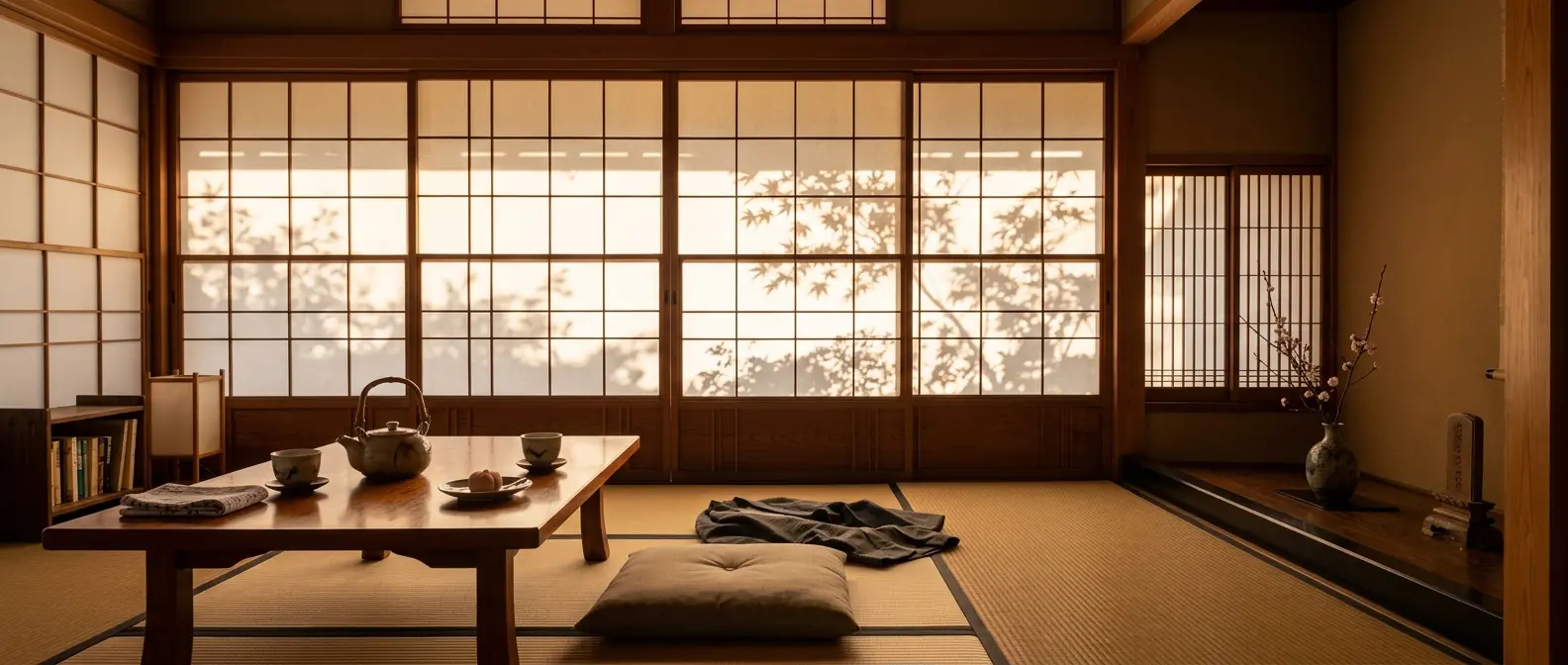
A gentle breeze passing through an open screen, the sound of rain on the roof or the shadow of moving branches projected onto paper panels all contribute to the atmosphere of the home.
The surrounding landscape is therefore not merely viewed from inside the building. It becomes an active participant in the experience of the space.
Light as a Building Material
In many architectural traditions, light is primarily understood as something that reveals forms.
Japanese design often treats it as a material in its own right.
Soft daylight filtered through washi paper, reflections on wooden surfaces or carefully controlled openings create environments where brightness changes gradually rather than abruptly. Shadows are not regarded simply as the absence of light but as elements that shape the perception of space.
Because natural illumination changes continuously, no room appears exactly the same throughout the day. Morning light produces different colours and textures from those of late afternoon, while overcast weather creates an entirely different atmosphere.
Rather than seeking complete visual uniformity, designers allow the character of a place to evolve with the movement of the sun.
Materials That Continue to Live
Traditional Japanese buildings make extensive use of materials such as wood, bamboo, paper, clay and stone.
Unlike synthetic surfaces designed to remain unchanged, these materials continue to respond to their surroundings.
Wood expands and contracts with humidity. Bamboo gradually develops a deeper colour. Clay walls absorb and release moisture according to the seasons. Even paper subtly alters its appearance under changing light.
Because these materials remain connected to natural processes, they invite regular care and maintenance instead of promising permanent perfection.
The designer does not attempt to stop time. Instead, the building is expected to mature together with its environment.
Seasonal Design
The influence of the seasons extends far beyond architecture.
Interior decoration often changes throughout the year. Scroll paintings displayed in the tokonoma alcove may be replaced according to the season, while flower arrangements introduce plants that belong to a particular moment rather than remaining constant throughout the year.
Tableware also reflects seasonal awareness. Colours, patterns and materials are frequently selected to complement the weather or the food being served.
Summer may favour cool-looking glass or pale ceramics, while autumn encourages warmer tones and heavier textures. These choices do not simply decorate a meal; they reinforce the connection between daily life and the natural cycle.
In this way, design becomes a living practice that evolves alongside the changing year.
Simplicity as Adaptability
The restrained appearance often associated with Japanese interiors is sometimes interpreted as a purely aesthetic preference.
In reality, simplicity frequently serves practical adaptability.
Rooms with movable partitions can change function throughout the day. Lightweight furnishings allow spaces to be reorganised according to need. Minimal decoration leaves room for seasonal objects or temporary arrangements without creating visual clutter.
This flexibility reflects an understanding that everyday life is constantly changing.
Instead of designing highly specialised spaces intended for a single purpose, traditional interiors often provide open frameworks capable of supporting different activities over time.
Nature itself becomes a model for this adaptability. Just as landscapes evolve without losing their identity, living spaces can change while preserving their essential character.
Respecting Rather Than Dominating
The relationship between people and nature expressed through Japanese design is not based on the idea of complete control.
Gardens require continual care, yet they are rarely forced into strict geometric order. Buildings provide shelter while remaining sensitive to changing weather. Materials are shaped by human hands but continue to display their natural characteristics.
This approach recognises that design is always part of a larger environment.
Rather than treating nature as an obstacle to overcome, it accepts environmental conditions as valuable contributors to the final experience.
Such an attitude does not reject technology or innovation. Contemporary Japanese architecture frequently combines advanced engineering with principles that have existed for centuries, demonstrating that respect for natural processes remains compatible with modern construction.
A Different Understanding of Design
Viewing nature as a design principle ultimately changes the role of the designer.
The objective is no longer to create objects or spaces that impose themselves upon their surroundings. Instead, design becomes an act of listening: observing light before placing a window, considering seasonal change before choosing materials, or allowing a landscape to influence the organisation of a building.
The resulting environments often appear calm, but their tranquillity is not accidental. It emerges from countless decisions that acknowledge the continuous interaction between people and the natural world.
This perspective invites a broader understanding of design itself. Beauty is not created solely through form or decoration, but through relationships—between light and shadow, interior and exterior, permanence and change.
By accepting that nature is not something separate from human life but an active presence within it, Japanese design offers more than an aesthetic tradition. It presents a way of thinking in which every space remains connected to the world that surrounds it.