
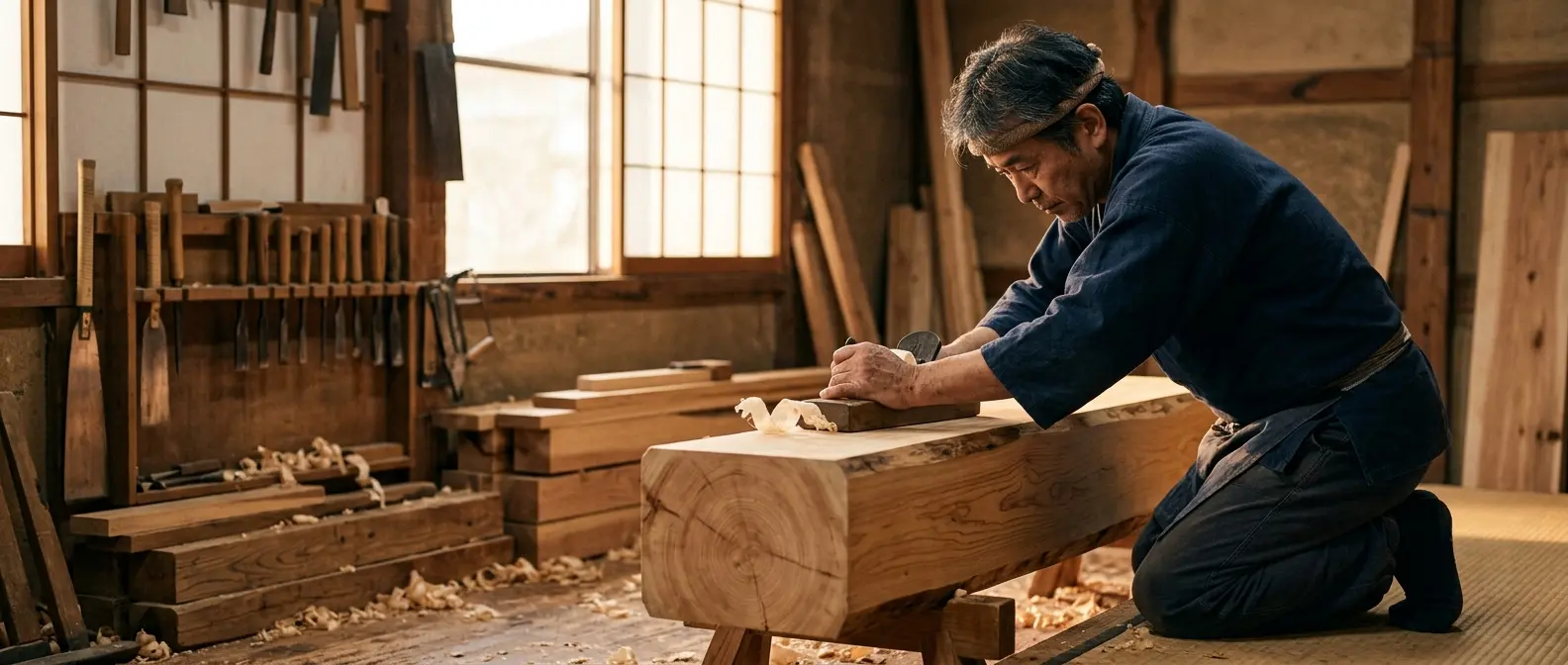
Among Japan’s traditional crafts, woodworking represents one of the clearest examples of harmony between human skill and natural materials. For centuries, Japanese carpenters have developed techniques based on an intimate understanding of wood: its strength, flexibility, grain and ability to change over time.
Rather than forcing the material into a predetermined form, traditional Japanese woodworking seeks cooperation with the natural qualities of the wood itself. The result is a craft where technical precision and aesthetic sensitivity become inseparable.
From ancient temples and shrines to contemporary furniture and architecture, Japanese woodworking continues to demonstrate that simplicity does not come from reducing complexity, but from mastering it.
Demo Content Notice
Every article on this website is created to showcase the design features and content possibilities of this WordPress theme. The content about Japan is provided for illustrative purposes, may include simplified descriptions or minor inaccuracies, and should not be considered a substitute for official or authoritative sources.
A Tradition Built Around the Material
Wood has always played a central role in Japanese architecture. The abundance of forests across the Japanese archipelago provided a wide variety of materials, each with different characteristics.
Cypress (hinoki), cedar (sugi) and pine (matsu) became essential elements of traditional construction. Among them, Japanese cypress gained particular importance for sacred buildings because of its durability, fragrance and resistance to humidity.
Traditional carpenters did not treat wood as an anonymous building material. Each piece was selected according to its qualities, with attention paid to the direction of the grain, the age of the tree and the way it would interact with the surrounding structure.
This careful approach reflects a broader Japanese understanding of craftsmanship: the material itself has a character that must be respected.
The Precision of Joinery
One of the most remarkable aspects of Japanese woodworking is the use of complex wooden joints instead of metal fasteners.
Techniques such as tsugite (継手) and shiguchi (仕口) allow different pieces of wood to be connected through carefully carved shapes that lock together with extraordinary precision. These methods can create strong structures without relying on nails, screws or adhesives.
The absence of visible hardware is not only a technical achievement but also an aesthetic choice. The finished structure appears simple and natural, revealing the beauty of the wood rather than hiding it beneath additional elements.
Creating these joints requires years of training. A small error in measurement or carving can compromise the entire structure, making precision one of the defining values of Japanese carpentry.
The World of the Miyadaiku
Among the most respected Japanese craftsmen are the miyadaiku (宮大工), carpenters specialised in the construction and restoration of temples and shrines.
Their knowledge has been passed down through generations, preserving techniques that have allowed wooden structures to survive for centuries.
Working on sacred buildings requires not only technical ability but also an understanding of traditional proportions, religious symbolism and historical methods. The carpenter becomes both a builder and a guardian of cultural heritage.
The restoration of ancient temples often follows the principle of preserving the original spirit of the building rather than simply replacing old elements with new ones. Damaged components may be carefully reconstructed using traditional methods, maintaining the connection between past and present.
Temples, Shrines and the Passage of Time
Japanese wooden architecture reveals a distinctive relationship with time.
Many traditional buildings are designed not as permanent objects that resist change forever, but as structures that require continuous care and renewal. This approach recognises that materials age and that preservation is an ongoing process.
The famous rebuilding tradition of certain Shinto sites, such as periodic reconstruction practices, reflects this idea of continuity through renewal. The value of the building lies not only in its original materials, but also in the knowledge and skills transmitted through each generation.
In this sense, traditional woodworking is not simply about preserving objects. It is about preserving relationships between people, materials and techniques.
Tools Guided by the Hand
Traditional Japanese carpentry tools are designed to maximise control and sensitivity.
The Japanese plane (kanna), for example, can produce extremely thin shavings, allowing craftsmen to create exceptionally smooth surfaces. Saws, chisels and marking tools are carefully adapted to the specific requirements of the craft.
Unlike industrial production, where machines often prioritise speed and repetition, traditional woodworking depends on the connection between the artisan and the tool.
The craftsman does not simply operate equipment; years of experience transform each movement into a precise and intuitive action.
From Sacred Architecture to Contemporary Design
Although Japanese woodworking has deep historical roots, it continues to influence contemporary design.
Modern furniture makers and architects often draw inspiration from traditional principles: the appreciation of natural materials, the importance of proportion, and the beauty of functional simplicity.
The influence of Japanese woodworking can be seen in minimalist interiors around the world, where exposed wood, clean lines and careful construction reflect ideas developed over centuries.
Contemporary artisans also continue to experiment with traditional joinery, applying ancient knowledge to new contexts. The techniques created for temples and houses can now be found in furniture, objects and modern architectural projects.
A Craft of Patience and Balance
Japanese woodworking represents more than a collection of technical skills. It expresses a particular way of approaching creation.
The carpenter does not dominate the material but develops a dialogue with it. The final object reflects both human intention and the natural qualities of the wood.
This balance between precision and respect for nature explains why Japanese woodworking continues to inspire admiration worldwide. Its beauty does not come from decoration or excess, but from the harmony between structure, material and purpose.
Through generations of craftsmen, wood has been transformed into temples, homes and everyday objects that carry the memory of human hands.
Japanese woodworking traditions remind us that true craftsmanship is not only about creating something that lasts, but about understanding how it belongs within the world around it.