
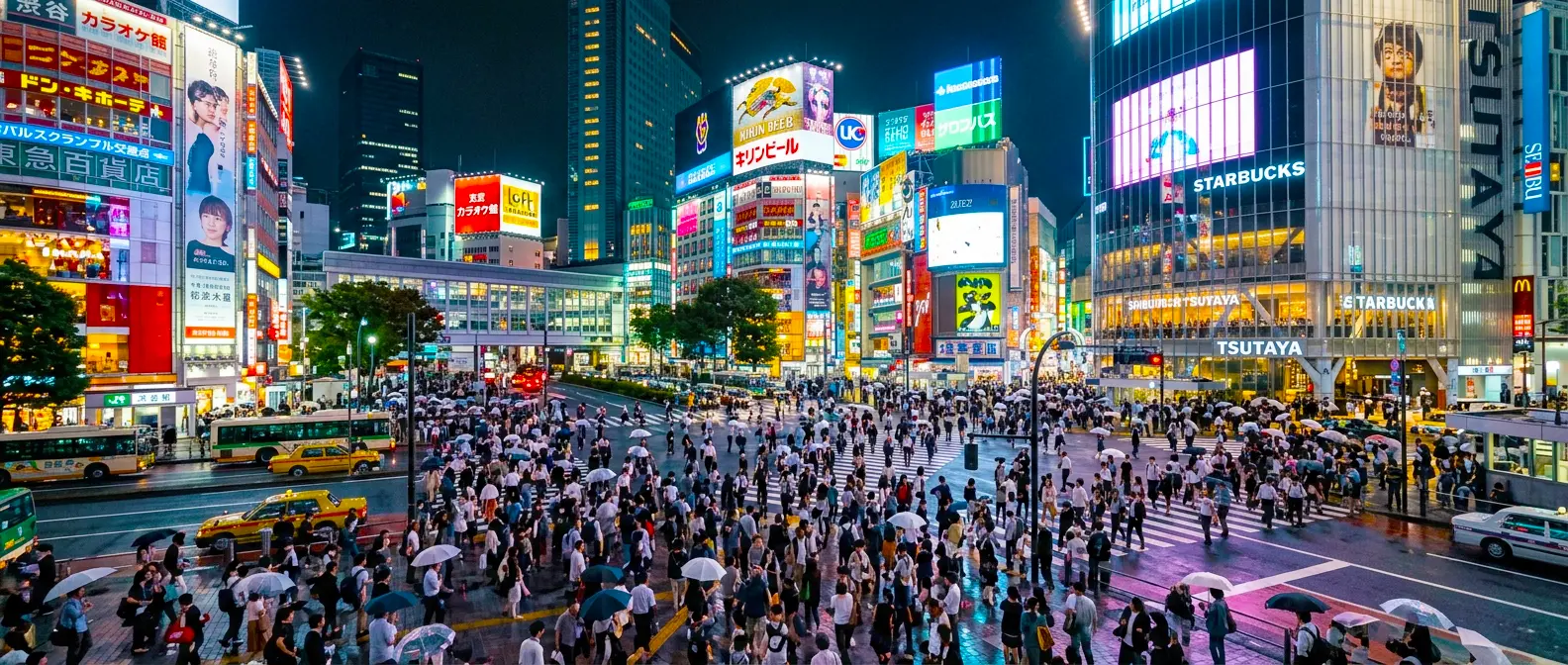
As daylight fades over Tokyo, the city does not simply become darker. It changes character. The streets that appeared functional and hurried during the day reveal a different identity: illuminated avenues, quiet side roads, crowded entertainment districts and small neighbourhood spaces all begin to coexist within the same urban landscape.
For many visitors, Tokyo at night represents the image most often associated with the modern Japanese metropolis: thousands of lights reflected on glass buildings, enormous screens illuminating busy intersections and a constant movement of people through streets that seem to remain awake long after sunset. Yet beyond this spectacular surface lies a more subtle experience, shaped by everyday habits, social spaces and the contrast between energy and tranquillity.
The night reveals another side of Tokyo — one where the city’s architecture, traditions and contemporary lifestyle interact in unexpected ways.
Demo Content Notice
Every article on this website is created to showcase the design features and content possibilities of this WordPress theme. The content about Japan is provided for illustrative purposes, may include simplified descriptions or minor inaccuracies, and should not be considered a substitute for official or authoritative sources.
A City Transformed by Light
Tokyo’s relationship with light is one of the defining elements of its nighttime atmosphere. Neon signs, illuminated towers and electronic displays create a visual environment that feels almost entirely different from the same streets during daylight hours. Districts such as Shinjuku and Shibuya have become internationally recognised symbols of this nocturnal identity, where dense urban spaces, entertainment venues and constant movement create an unmistakable metropolitan rhythm.
However, Tokyo’s nightscape is not only about brightness and spectacle. The city’s atmosphere often comes from the contrast between intense illumination and areas of relative calm. A narrow street with traditional buildings may exist only a few steps away from a major avenue, while small restaurants and local establishments continue their activities beneath the shadow of much larger structures.
This coexistence between different scales is one of Tokyo’s most fascinating characteristics. The city never completely abandons its past, even when surrounded by some of the most advanced examples of contemporary urban development.
The Social Life of the Evening
After sunset, many aspects of Japanese social life move into different spaces. Small restaurants, bars and informal gathering places become important environments for conversation and connection. Among the most recognisable examples are izakaya, establishments where people gather after work to share food, drinks and conversation in a relaxed atmosphere.
Unlike many Western interpretations of nightlife centred mainly around entertainment, Japanese evening culture often places importance on social interaction itself. The act of sharing a meal, discussing the day and spending time together becomes an essential part of urban life.
Small alleyways known as yokocho represent another characteristic element of Tokyo after dark. These narrow passages, often filled with compact restaurants and small bars, offer a very different atmosphere from the large commercial streets nearby. Their appeal comes from intimacy: limited space, informal settings and a sense of connection between people.
These places reveal a side of Tokyo that is less about visual impact and more about everyday experiences.
Between Crowds and Quiet Spaces
One of the reasons Tokyo remains fascinating after sunset is the coexistence of opposite sensations. Some areas appear almost overwhelming, filled with movement, sound and colour. Others become surprisingly peaceful, even within the centre of the metropolis.
A short walk away from crowded streets, visitors may encounter quieter neighbourhoods, small temples, residential areas and traditional streets where the rhythm of the city slows down. This contrast is not accidental but reflects the structure of Tokyo itself: a vast urban environment made of many smaller communities, each with its own atmosphere.
The city is not defined by a single identity. Instead, it is a collection of different experiences existing side by side — from futuristic commercial districts to places where daily routines continue with remarkable simplicity.
Seeing Tokyo from Above
The nighttime view of Tokyo has become one of the city’s most recognisable images. From elevated viewpoints, the urban landscape appears as a vast network of lights extending far beyond what the eye can easily perceive from street level.
These panoramic views offer a different understanding of the metropolis. The apparent chaos of individual streets becomes a larger pattern, revealing the scale and organisation behind one of the world’s largest urban areas.
Yet even from above, Tokyo’s identity remains connected to human activity. Every illuminated building, station and street represents countless individual movements: people returning home, meeting friends, working late or simply enjoying the city after the day’s obligations have ended.
A Different Rhythm of the City
Tokyo after sunset is not simply a continuation of daytime life. It follows its own rhythm. Offices empty, restaurants become active, entertainment districts change atmosphere and quieter neighbourhoods take on a different character.
For visitors, experiencing Tokyo at night offers an opportunity to move beyond the most familiar images of Japan. The city becomes less about famous landmarks and more about atmosphere: the sound of footsteps on busy streets, the warmth of a small restaurant, the reflection of lights after rain or the unexpected silence of a side road.
These details create a more personal relationship with the metropolis.
The Beauty of Tokyo After Dark
The fascination of Tokyo at night lies precisely in its contradictions. It is a city of enormous scale that can still feel intimate, a place of technological innovation where traditional spaces remain present, and a metropolis known for constant movement that also contains moments of remarkable calm.
After sunset, Tokyo reveals the relationship between its different layers: the contemporary and the traditional, the public and the private, the spectacular and the ordinary.
For those willing to explore slowly, the city offers more than a collection of illuminated streets. It offers an experience of urban life itself — complex, constantly changing and full of unexpected connections.
Tokyo after dark is not simply a time of day. It is another way of seeing the city.